

Who Actually Needs Industrial-Grade
Not everyone does. That’s worth saying directly.
If your product catalog is straightforward, your pricing is simple, and your configurations don’t involve thousands of dependencies, then lightweight CPQ probably works fine.
Industrial-grade becomes necessary when:
Configuration complexity is real. Your products have genuine interdependencies. Selecting one option affects what’s valid elsewhere. Technical constraints matter and need enforcement.

Quote outputs drive downstream processes.
The quote isn’t the end. it’s the beginning. Manufacturing needs BOMs. Project teams need scopes. It all needs to be actionable.

You've outgrown your current tool.
You’re already working around limitations. Your CPQ admin is a bottleneck. “Simple changes” take weeks.

Integration actually matters.
You need CPQ to work with your CRM and ERP natively, not fight with it through sync jobs and middleware.

Compliance is mandatory.
Errors and gaps in governable data create risk. When a configured product doesn’t meet regional specifications requirements, it doesn’t just cost you revenue; it also reduces customer trust.
How to Spot Industrial-Grade CPQ
Industrial-grade CPQ solutions thrive in high-complexity environments. When we say “industrial-grade,” we’re also referring to a set of capabilities designed for scenarios that have one thing in common: your organization needs to support high complexity at a sustainable cost.
Depth of configuration logic.
Not just “if-then” rules, but nested conditions, cross-product dependencies, and constraint validation that scales. When you need a thousand rules that interact correctly, the architecture either supports that or it doesn’t.
Volume tolerance.
Maintainability under complexity.
Integration depth.
Industrial-grade CPQ occupies specific territory: enterprise-level scalability with operational simplicity and agility.
Where Lightweight CPQ Breaks
Lightweight tools work well within their design parameters. The problem is those parameters are narrower than vendors admit.
Here’s what typically triggers the breaking point:
Pricing sophistication.
Scale.
Rule complexity.
You add your 200th configuration rule and suddenly quotes take 30 seconds to calculate. Or rules start conflicting in edge cases nobody tested. The engine wasn't built for that density.
Product interdependencies.
Multi-level outputs.
None of these are exotic requirements.
They’re what happens when a business grows or when products get more sophisticated.
However, complex businesses often hit the scalability ceiling of lightweight CPQ a lot faster than expected.
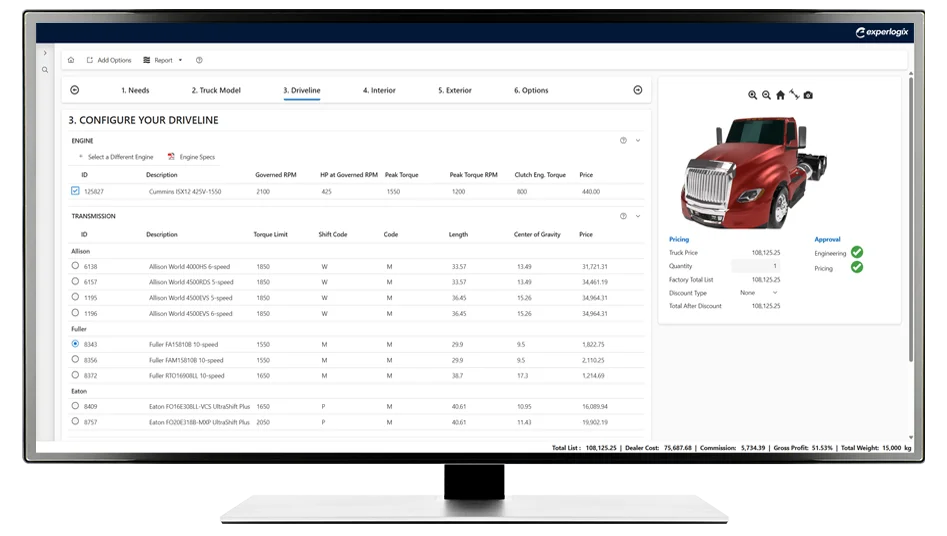
See It in Practice
Complexity is easier to assess than describe. If your configurations are sophisticated enough that you’re reading a page like this one, they’re probably sophisticated enough to warrant a conversation.
We can show you how Experlogix handles scenarios similar to yours.