With the end-of-life announcement for the on-premise edition of SAP Commerce (formerly SAP Hybris), B2B organisations across the UK, Ireland and the United States are reassessing their digital commerce strategy.
For many manufacturers, distributors and wholesalers, this is more than a technical upgrade. It is a strategic decision:
- Move to SAP’s cloud edition
- Re-implement on another enterprise platform
- Or modernise with a lower-risk SaaS alternative
This guide explores your options — and why many B2B organisations are choosing a different path.
Why SAP Commerce Customers Are Re-Evaluating Their Platform
- End of Life for On-Premise SAP Commerce
SAP has confirmed end-of-life timelines for legacy on-premise deployments. For affected organisations, this typically means:
- A migration to SAP Commerce Cloud
- A costly re-platforming project
- Or a full digital commerce reset
In practical terms, this often feels less like an upgrade and more like a complete reimplementation.
- Enterprise Complexity — Enterprise Cost
Platforms such as SAP Commerce and Adobe Commerce are undeniably powerful.
However, B2B organisations in the UK, Ireland and US frequently report:
- Multi-year implementation cycles
- Significant system integrator dependency
- High licensing and infrastructure costs
- Heavy customisation footprints
- Ongoing DevOps overhead
In many cases, businesses are using only a subset of the functionality — while absorbing the full cost and complexity.
Do Most B2B Organisations Actually Need SAP Commerce?
SAP Commerce was designed to support highly complex global B2C and B2B scenarios.
Yet most B2B organisations primarily require:
- Secure customer portals
- ERP-driven pricing and inventory
- Multi-user account management
- Repeat ordering & quick order tools
- Quotation workflows
- PunchOut catalogues
- Multi-currency & multi-region support
These are critical capabilities — but they do not necessarily require a heavyweight, custom-engineered platform.
The question many IT and digital leaders are now asking:
Are we paying for architectural capability we don’t truly need?
SAP Commerce vs Adobe Commerce vs Experlogix Digital Commerce
Below is a practical comparison for mid-market and upper mid-market B2B organisations.
Adobe Commerce vs SAP Commerce: Is It a Simpler Option?
Adobe Commerce is frequently shortlisted by organisations moving away from SAP Commerce.
It offers:
- Flexibility
- Large partner ecosystem
- Strong content and merchandising tools
However, for B2B companies in the UK, Ireland and US, projects often still involve:
- Significant customisation
- Extension management
- Hosting optimisation
- Performance tuning
- Ongoing technical resource requirements
For some organisations, that is the right strategic move.
For others, it simply replaces one complex implementation with another.
A Modern Alternative: Experlogix Digital Commerce
Experlogix Digital Commerce is purpose-built for B2B ecommerce and customer portals — particularly for ERP-driven organisations.
Rather than leading with platform complexity, Experlogix focuses on:
- Practical B2B functionality
- ERP alignment
- Rapid time to value
- Lower long-term risk
Built for B2B from Day One
Experlogix delivers out-of-the-box capabilities including:
- Account-specific pricing
- Complex product catalogues
- Multi-entity account hierarchies
- Self-service portals or B2B eCommerce deployments
- Full Quote-to-order and order-to-cash workflows
- Punchout Catalog support
- UoM, Product Options, Configuration, Suppression and many other common B2B features
- Security & scalability
Without requiring extensive custom code.
True SaaS — Not Repackaged On-Premise
Experlogix Digital Commerce is:
- Multi-tenant SaaS
- Fully managed infrastructure
- Automatically upgraded
- SOC 2 compliant
This is particularly relevant for organisations in regulated industries across the UK, Ireland and US where security and compliance are non-negotiable.
ERP-Centric by Design
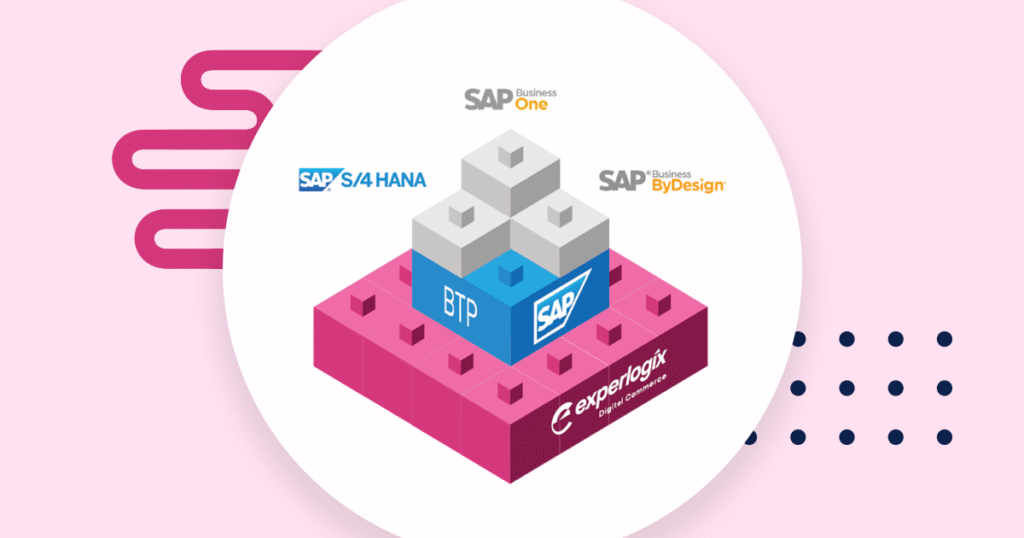
Experlogix is designed to sit naturally within ERP-driven commerce environments, reducing integration complexity and implementation risk. Experlogix supports many SAP ERPs
- SAP ECC,
- S/4HANA,
- SAP Business One,
- As well as Dynamics365 and any other Global ERPs.
Thus, Experlogix have the knowledge and knowhow to advise and support SAP ERP customers into the future.
Total Cost of Ownership: A Practical Comparison
When organisations evaluate alternatives to SAP Commerce, the conversation often shifts from feature comparison to financial reality.
Key cost considerations:
For many mid-market and upper mid-market B2B companies, the difference in total cost of ownership over 3-5 years can be substantial.
Who Should Consider Moving from SAP Commerce?
Experlogix Digital Commerce is particularly suited to:
- Manufacturers with complex pricing structures
- Distributors with large catalogues
- Wholesalers requiring customer-specific workflows
- ERP-centric organisations seeking reduced integration risk
- Companies looking to avoid 12–18 month reimplementation cycles
If your organisation:
- Does not fully utilise SAP Commerce’s advanced enterprise features
- Wants predictable SaaS economics
- Needs strong B2B functionality without over-engineering
- Is prioritising speed and risk reduction
Then it may be time to consider a modern alternative.
Final Thoughts: Rethinking Enterprise Commerce in 2026
The end-of-life announcement for SAP Commerce on-premise creates urgency — but it also creates opportunity.
For B2B organisations across the UK, Ireland and US, this is a moment to ask:
- Do we need another heavyweight enterprise re-platform?
- Or do we need a secure, scalable, ERP-aligned SaaS solution built specifically for B2B?
Enterprise-grade digital commerce does not have to mean enterprise-level complexity.
Experlogix Digital Commerce offers:
- Faster implementation
- Lower risk
- Lower total cost of ownership
- Built-in compliance
- Strong ERP integration
- Scalable SaaS architecture
All without the burden of a complex reimplementation project.