
SuranceBay is best known in life, annuity and benefits distribution as the producer-facing layer that carries agents, agencies, independent marketing organisations (IMOs), field marketing organisations (FMOs) and broker-dealers through contracting, licensing verification, carrier appointment and ongoing compliance records. The platform owns the producer record and the contracting journey; what tends to spill outside it is everything the business wants to do with that producer data — commission schedules, agency hierarchy confirmations, onboarding packets, carrier-ready submission bundles, jurisdiction-specific notices, training attestations and renewal correspondence. When those documents are assembled by hand, or coded into templates that only a developer or consultant can safely touch, distribution teams end up waiting on IT for wording changes that the business owns in substance.
TL;DR
- SuranceBay’s role is producer distribution management: contracting, licence and appointment data, carrier-specific paperwork and compliance records — not enterprise-wide document generation across policy, billing and claims.
- Document complexity around SuranceBay comes from carrier-specific contracting forms, state, province and regional licensing rules, hierarchy and commission variations, and data that lives in several systems at once.
- A governed document layer sits alongside the platform: the producer system stays the source of truth for contracting status, while templates, business rules, approvals, delivery and evidence are centrally managed.
- Experlogix Document Automation is one way insurers and distributors do this, using a Microsoft Word-based low/no-code template builder, Smart Forms for missing data, Smart Flows for workflow, and a flexible application programming interface (API) with role-based API keys for integration.
- AI can accelerate configuration and assist workflow initiation, but regulated decisions — appointment eligibility, suitability, commission terms — stay with authorised people and systems, with every generated document traceable.
Happy shiny people. Insurance marketing loves the image of policyholders living their best lives, untroubled by the catastrophes their cover protects against. A centralised document layer that lets operations and compliance teams make accurate document changes quickly, without heavy ongoing IT labour, is how the insurance professionals behind those campaigns get to live their best lives too.
What SuranceBay Actually Owns in the Distribution Lifecycle
Before discussing document automation around SuranceBay, it helps to be precise about scope. SuranceBay is not a policy administration or claims system. Its centre of gravity is producer onboarding and distribution compliance: capturing producer profiles, background and disclosure questions, licence and appointment information, carrier contracting requirements, anti-money-laundering (AML) and errors-and-omissions (E&O) evidence, and the state of a producer’s readiness to sell.
That distinction matters for document strategy. The documents that cluster around a producer platform are contracting and relationship documents rather than policy artefacts: contracting packets, agency and sub-agency agreements, commission schedules and amendments, hierarchy confirmations, appointment notifications, licence-lapse and renewal reminders, continuing-education and training attestations, termination and for-cause notices, and periodic compliance attestations.
They are lower volume than a renewal cycle, but they are not simple. Each one is conditioned by carrier, product line, jurisdiction, distribution channel and the producer’s position in a hierarchy. A single wording change in a commission schedule can touch dozens of variants.
Why producer documents are deceptively hard
- Carrier-specific requirements. Each carrier in a distributor’s portfolio has its own contracting pack, its own required disclosures and its own ordering and formatting expectations.
- Jurisdictional variation. Licensing and appointment rules differ by state, province and region, and effective dates shift as regulators publish changes. The document that was correct in March may not be correct in September.
- Hierarchy and compensation logic. Upline and downline relationships drive which schedule, which overrides and which notice text apply. That is conditional logic, lookups and calculations — traditionally the point at which a business requirement becomes a developer ticket.
- Multi-system data. Producer status may live in the producer platform, while entity and banking details sit in finance systems, agreements sit in a content repository, and sales relationships sit in customer relationship management (CRM). Few producer documents draw from only one source.
- Evidence obligations. For audit and regulator enquiries, it is rarely enough to have the document. You need to know which version of which template, with which data, was approved by whom, delivered how, and retained under which rule.
Where Document Work Leaks Out of the Platform

Most distribution organisations find that producer platforms handle the structured part of onboarding very well and that document work leaks out at the edges. Typical leak points include:
The common pattern is that the platform knows the facts, and a human assembles the document. That is where turnaround time and inconsistency enter.
Before contracting is complete. Recruiting materials, pre-appointment summaries and agency proposals are often produced in Word or slide decks, assembled by an operations analyst, and stitched together with copy-and-paste from the producer record.
At contracting and appointment. Carrier-ready packets may need assembly from multiple sources, with conditional inclusion of jurisdiction-specific forms and signature pages routed for electronic signature before submission.
During the relationship. Commission schedule amendments, hierarchy change confirmations, product authorisation notices and bulletin-style communications to a filtered producer population.
At renewal and compliance checkpoints. Licence expiry and continuing-education reminders, annual attestations, AML certificate requests and E&O evidence requests — high in volume at predictable peaks.
At exit. Termination notices, for-cause documentation, final commission statements and regulatory notifications where wording is tightly controlled.
Native Output Versus a Governed Document Layer
Producer and distribution platforms generally include document capabilities, and those capabilities serve their purpose well. The practical question is not whether a platform can produce a document — it is which documents belong where.
A reasonable boundary test:
Keep native documents that are tightly coupled to a single system’s own transaction and lifecycle, where the output rarely changes, where the data lives entirely in that system, and where the platform’s own audit trail is sufficient.
Consider a dedicated document layer when a document draws data from more than one system, when the same content must be reproduced across several platforms and brands, when wording changes frequently under compliance pressure, when business users rather than developers should own the wording, when jurisdiction and effective-date variants multiply, or when the organisation wants one consistent approval, delivery and evidence pattern across all document-producing systems.
This is an architectural option, not an obligation. Many organisations run both: native output for the system-bound transactional pieces, and a centralised document layer for the cross-system, business-owned, frequently changing material.
The centralisation argument
A distributor rarely runs only one system. A governed document layer can centralise templates, branding, business rules, approvals and delivery across a producer platform, a CRM, a commission or finance system and a content archive. That means one commission schedule template estate rather than four, one approval route rather than four, and one audit trail rather than four reconciled by spreadsheet.
Integration Architecture: A One-Time Setup with Long-Term Leverage
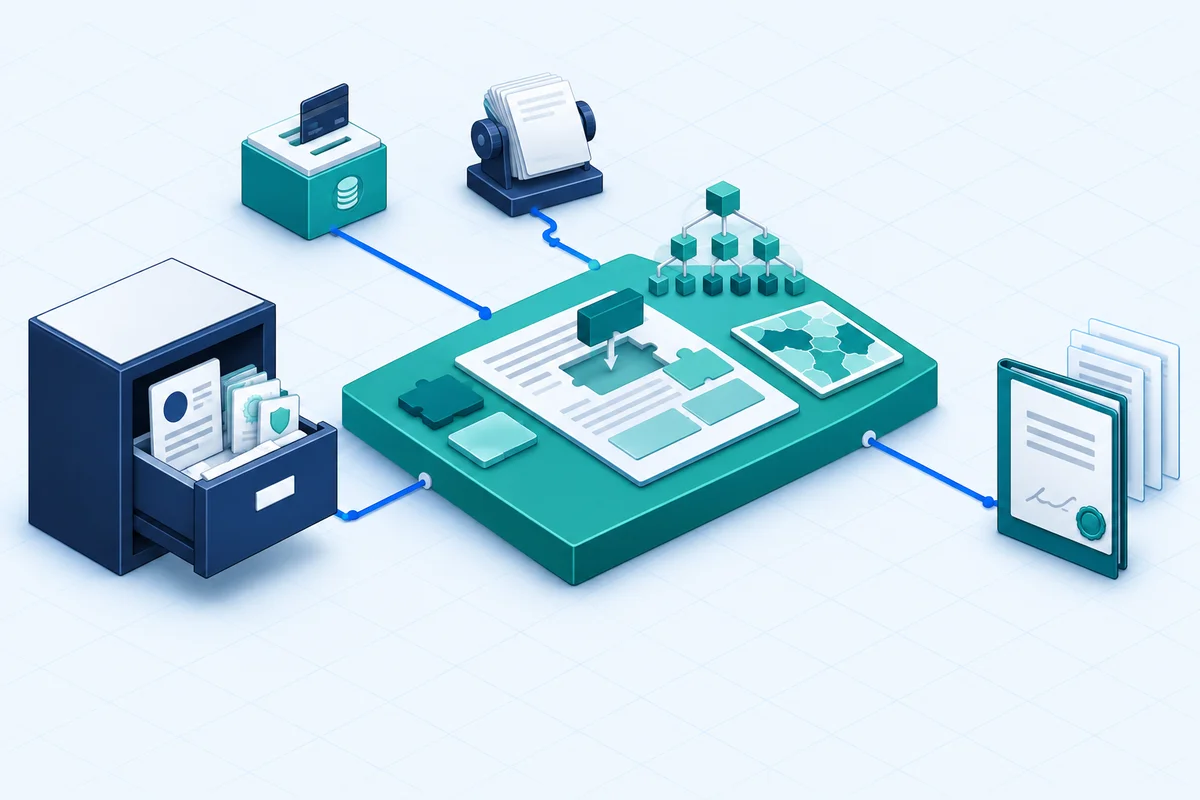
API-led integration is the natural way to connect a producer platform to a centralised document layer, and it is a strength rather than a compromise. Experlogix Document Automation provides a flexible API with features such as role-based API keys, an extensive library of API calls and programmable functionality for building dynamic document workflows, and the solution can connect to an unlimited number of data sources. Out-of-the-box integrations exist for major business platforms including Microsoft Dynamics 365, Salesforce and NetSuite, and the API allows document automation capabilities to be embedded into virtually any application.
What that looks like in practice around a producer platform:
-
A trigger. A contracting status change, an appointment confirmation, a licence expiry threshold, a hierarchy change, or a scheduled batch for attestation season.
-
A data contract. An agreed set of fields and structures, including nested data such as hierarchy branches or multi-state licence arrays, with explicit rules for missing values rather than a blank space in a legal document.
-
Rules and template selection. Carrier, product line, jurisdiction, language, brand and effective date determine which template and which clause variants apply.
-
Assembly. Conditional logic, filtering, calculations and lookups applied at generation time, drawing from the producer platform plus finance, CRM or content sources.
-
Approval and signature. Routing to compliance or distribution leadership where required, then participation in electronic signature where a producer signature is needed.
-
Delivery and archive. Email, portal, print or secure distribution, with the final artefact filed into the archive with searchable metadata.
-
Write-back. A status, reference and link returned to the producer record so the platform remains the operational source of truth.
Security and identity deserve explicit attention: producer records carry personal data, tax identifiers and background disclosures. Role-based access, service identities for machine-to-machine calls, and retention rules matched to the sensitivity of the content should be settled during design, not retrofitted. Experlogix maintains compliance with standards such as SOC 2 and follows industry guidance including NIST and OWASP for security practices.
Failure paths are the part most designs under-specify
Happy-path generation is the easy half. The design questions that separate a durable architecture from a fragile one are: what happens when the same event fires twice; whether generation is idempotent; how retries behave; what happens when a batch of 4,000 attestation reminders completes 3,850 of them; how delivery failures are surfaced and to whom; how write-back errors are reconciled; and how a historical document is reproduced later with its original template version and effective-dated wording intact rather than today’s.
Peak testing matters too. Attestation season, mass carrier re-contracting and annual licence renewal cycles are the producer-side equivalent of a renewal peak, and they should be load-tested against realistic volumes and document lengths.
Business Ownership Without Losing Control
The strongest operational argument for a dedicated document layer is ownership. Experlogix uses a low/no-code template builder that leverages the same functionality as Microsoft Word, so business users can build and maintain templates — simple or complex, including text, images and analytics — without coding knowledge and within familiar software. Where source data is missing, Smart Forms allow customisable forms to be included in an automated workflow: a flow can send a link to a form, and completing the form can trigger document generation. That is a direct answer to the producer-onboarding reality where some required information simply does not exist in any system yet.
Smart Flows extends this into workflow, letting business users create, generate, manage, store, deliver and e-sign documents without code, and it integrates with Microsoft Power Automate — supporting automated, button, scheduled and business-process flows, including approval processes, and working with SharePoint document libraries and other connected applications.
The governance split that tends to work is straightforward: operations and compliance own wording, clause variants, approval routes and template versions; IT owns integration, identity, environments, monitoring and release control; product and compliance own jurisdiction, edition and effective-date decisions. IT sets the solution up once, then empowers the business to run it — which is precisely the dependency reduction that distribution leaders ask for when a carrier changes a contracting form with six weeks’ notice.
Reduced reliance on developers and consultants is not just a cost question. It is a cycle-time question: the gap between “compliance approved new wording” and “the new wording is in production” is where risk accumulates.
AI and Automation Within a Governance Frame

AI is reshaping insurance document workflows, and it is useful here in two distinct ways.
The first is configuration and authoring assistance: helping shape templates, suggest content, accelerate workflow design and support document review, with a human approving before anything reaches production.
The second is governed invocation. Experlogix Document Automation includes an MCP (Model Context Protocol) server. MCP is the emerging standard that allows AI agents to connect to existing systems — policy platforms, CRM, compliance engines — in a structured, auditable way, giving agents the context to act and giving the organisation the governance layer to define exactly how they act. In a producer context, that might mean a distribution manager asking an internal assistant to prepare a hierarchy change confirmation pack: the request initiates a defined workflow, the data is pulled from authorised systems, the approved template is selected by rule, approval routing applies, and the output is delivered and archived.
The boundary is firm. AI assists and initiates; it does not decide appointment eligibility, suitability, commission terms or compliance outcomes. Agents operate within parameters the organisation defines, every document generated through Experlogix is traceable, and every agent action is logged — the system is intended to operate as an auditable extension of existing workflow rather than a black box. Where processes are immature before AI is applied, AI tends to add complexity rather than productivity, so sequencing matters: fix the workflow, then add the intelligence layer.
Trade-Offs Worth Being Honest About
Adding a document layer adds an interface to operate, monitor and support. It introduces a second place where wording can live, which makes template governance a discipline rather than an afterthought. It requires agreement on who owns what, and that agreement is organisational work, not configuration work. And if only one or two low-variation documents are involved, native output may simply be the better answer.
The counterweight is that most distribution organisations do not have one or two documents. They have a sprawl of carrier packets, schedules, notices and attestations spread across systems and people — and the cost of that sprawl is usually paid in turnaround time, inconsistency and audit effort rather than in a line item anyone reviews.
Summary
SuranceBay occupies a specific and valuable position: the producer record, the contracting journey and the compliance state of a distribution force. The document opportunity around it is not to replace that role but to professionalise everything that happens to those facts once they become a document.
The decisions that matter are boundary decisions. Identify the source of truth for each data element, the owner of each trigger, the owner of each template, the approver, the archive owner and the write-back owner — and be explicit about which documents stay native. Then design for the unglamorous parts: missing data rules, duplicate triggers, retries, partial batches, delivery evidence, effective-dated reproduction and retention.
A reasonable next step for most teams is to inventory the producer-related documents currently assembled by people rather than systems, score each one on variation, frequency of wording change and number of source systems, and start with the handful that score highest. Those are the documents where centralised templates, business-user ownership and API-driven generation pay back fastest — and where distribution operations stops being the bottleneck between a carrier’s requirement and a producer ready to sell.
Frequently Asked Questions
What role does SuranceBay play, and where does document production begin?
Before discussing document automation around SuranceBay, it helps to be precise about scope. SuranceBay is not a policy administration or claims system. Its centre of gravity is producer onboarding and distribution compliance: capturing producer profiles, background and disclosure questions, licence and appointment information, carrier contracting requirements, anti-money-laundering (AML) and errors-and-omissions (E&O) evidence, and the state of a producer's readiness to sell.
When is native document output enough alongside SuranceBay?
Producer and distribution platforms generally include document capabilities, and those capabilities serve their purpose well. The practical question is not whether a platform can produce a document — it is which documents belong where.
How should a governed document layer connect with SuranceBay?
API-led integration is the natural way to connect a producer platform to a centralised document layer, and it is a strength rather than a compromise. Experlogix Document Automation provides a flexible API with features such as role-based API keys, an extensive library of API calls and programmable functionality for building dynamic document workflows, and the solution can connect to an unlimited number of data sources.
Who should own document templates, approvals and governed changes?
The strongest operational argument for a dedicated document layer is ownership. Experlogix uses a low/no-code template builder that leverages the same functionality as Microsoft Word, so business users can build and maintain templates — simple or complex, including text, images and analytics — without coding knowledge and within familiar software.
What role should governance play in AI-assisted insurance document workflows?
AI is reshaping insurance document workflows, and it is useful here in two distinct ways. The first is configuration and authoring assistance: helping shape templates, suggest content, accelerate workflow design and support document review, with a human approving before anything reaches production.