
Organizations are investing heavily in AI, deploying AI Assistants, chatbots, and generative tools across every function. Yet most are seeing little to no measurable return. According to McKinsey, more than 78% of companies now use generative AI in at least one business function, yet more than 80% report no material contribution to earnings from those initiatives.
Why AI Agents Are the Answer
Most enterprise AI deployments today are horizontal: enterprise-wide AI Assistants and chatbots that enhance individual productivity but deliver diffuse, hard-to-measure gains. They respond to prompts. They summarize. They assist. But they don't execute.
AI agents represent the next evolution, systems that can understand goals, break them into subtasks, interact with both humans and enterprise systems, and take action with minimal human intervention. This shift is described as moving gen AI "from a reactive tool to a proactive, goal-driven virtual collaborator" — one capable of automating complex business workflows involving multiple steps, actors, and systems that were previously beyond the reach of first-generation AI tools.
An AI agent is not just a conversational interface. It is a goal-driven system designed to plan work, invoke tools, interact with enterprise systems, and execute tasks autonomously — with humans setting intent and boundaries rather than manually performing each step.
- Interpret intent, not just prompts
- Break goals into steps, rather than responding one request at a time
- Invoke enterprise tools and workflows, not just generate text
- Maintain context and state, allowing multi-step execution
- Take action, producing real business outputs (documents, records, transactions, and decisions)
The question for IT leaders and developers is no longer whether to build agentic systems, it's how to give those agents something real to act on.
What is an MCP Server? (The USB-C for AI)
AI agents are only as powerful as the tools they can reach. Until recently, connecting an agent to an enterprise system meant building a custom integration, and then building another one for every other system, every other agent, every other workflow.
The result: fragmented ecosystems, slow development cycles, and agents that remain isolated from the business processes that matter most.
Model Context Protocol (MCP) changes that equation. Originally developed by Anthropic and open-sourced in late 2024, MCP is rapidly becoming the standard interface for how AI agentic systems connect to external applications, earning the description of "USB-C for AI."
MCP follows a client-server architecture: an AI agent (the client) connects to an MCP server, discovers the tools and workflows available, and invokes them using a standardized protocol. The key advantage? It's a "write once, use anywhere" approach. An app developer builds one MCP server, and any MCP-enabled agent (Claude, Cursor, GPT, or any other) can connect to it without additional custom development.
Experlogix Smart Flows MCP Server
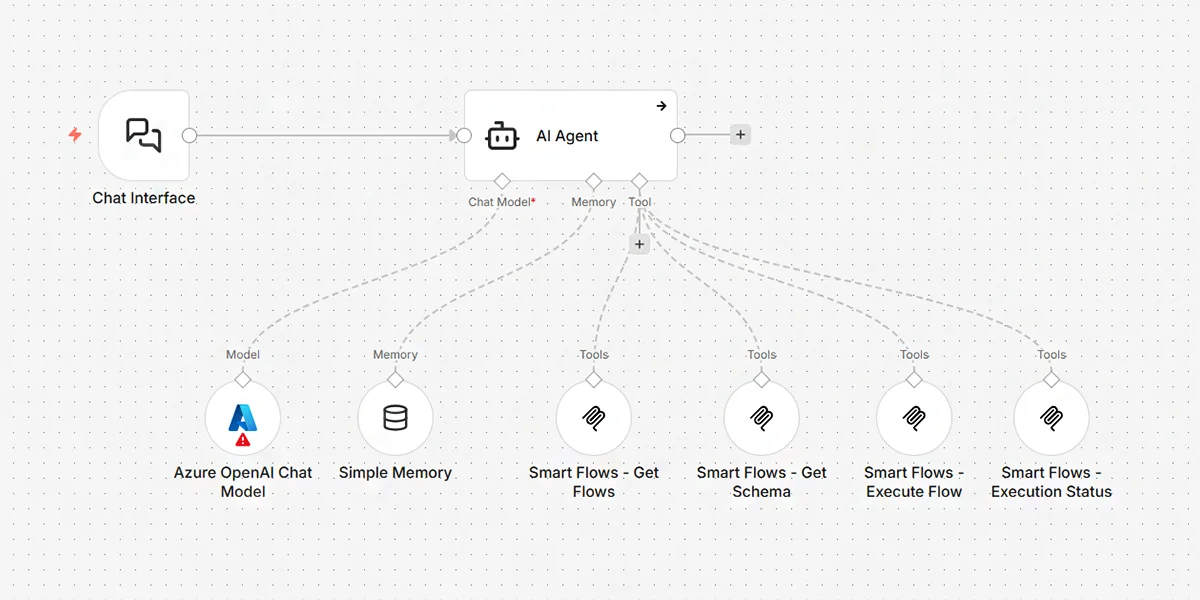
This is where Experlogix Document Automation becomes a strategic asset for your AI architecture. The Smart Flows MCP Server provides a standardized, supported way for any MCP-enabled AI agent to discover, execute, and interact with Experlogix Document Automation workflows.
Through the MCP server, an agent can:
- Discover which Smart Flows are available and what inputs they require
- Execute governed, template-based document workflows triggered by a natural language prompt
- Retrieve execution results and generated documents.
The result is an AI agent that doesn't just suggest, it acts. Whether you're generating a policy document, a contract, a proposal, or a compliance report, the agent can trigger a structured, auditable workflow and deliver a real output in seconds.
But what does that actually look like in practice? Here are three scenarios where the Smart Flows MCP Server turns agentic potential into measurable output.
Three Ways You can use the Smart Flows MCP Server
A customer interacts with a chatbot on your website to initiate an insurance claim. Today, that interaction typically ends with the bot directing them to a web form, a knowledge base article, or a hold queue. This leaves the customer to complete the process on their own.
With the Smart Flows MCP Server, the chatbot becomes an execution layer. It identifies the nature of the inquiry, determines the required forms and documents, and triggers the appropriate workflow directly from the conversation. The customer record is located, the correct web form is populated, and any required documents and signature requests are generated and sent automatically.
The customer receives what they need in seconds, without leaving the chat interface and without human intervention. Every step is traceable and recorded within existing systems of record.
The experience shifts from assisted navigation to instant resolution. That’s a measurably better customer outcome and a measurably lower cost to serve.
A sales rep is in a Copilot conversation reviewing an opportunity in Dynamics 365. They need to generate a customized proposal or statement of work before a client meeting in two hours. Normally, that means pulling data from CRM, opening a Word template, filling in fields manually, formatting, and chasing approvals.
With Smart Flows connected via MCP, the rep simply asks Copilot to generate the proposal. Copilot identifies the right workflow. It then passes the relevant deal data as structured inputs, and triggers the document workflow, producing a governed, branded, data-accurate document without the rep ever leaving their Copilot session.
For product managers and IT leaders, this matters beyond the time saved. It means document output becomes a consistent, repeatable, auditable process — not something that varies by rep, region, or how good someone is at finding the right template.
For developers and analysts building custom automation pipelines, the Smart Flows MCP Server removes one of the most persistent bottlenecks in document-intensive workflows: the gap between an orchestration layer and a compliant document output.
Consider a workflow that monitors regulatory changes, identifies impacted policy documents, and needs to automatically generate updated notices or disclosure forms for affected customers. A developer-built agent — using Claude, GPT, or any MCP-compatible orchestrator — can connect to the Smart Flows MCP Server, discover the relevant flows, and trigger high-volume document generation programmatically. No custom document logic embedded in the agent. No brittle integrations to maintain. Just a clean, governed execution layer that handles the document side of the workflow reliably and at scale.
The Competitive Edge Is Already in Motion
Its sited that fewer than 10% of vertical AI use cases ever make it past the pilot stage. Held back by technical complexity, siloed teams, and the inability to connect AI to the real workflows that drive business outcomes. The organizations that close that gap will be the ones that treat AI agents not as standalone tools, but as execution layers connected to governed, enterprise-grade automation.
The Smart Flows MCP Server is that connection. It turns any MCP-enabled AI agent into a workflow executor. It gives your agents something meaningful to act on and gives your organization a foundation for agentic AI that is both powerful and controlled.
Have questions or want to see it in action? Schedule a demo.