
EZLynx sits at the centre of day-to-day agency life — comparative rating, client and policy records, servicing activity, retention campaigns, and the client-facing touchpoints that independent agencies and brokerages depend on. Around it, agencies accumulate a wide range of document obligations: carrier-specific proposals, certificates and evidence of property insurance, renewal packets, binders, finance agreements, cancellation and non-renewal notices, commission statements, and a growing pile of jurisdiction-specific disclosures that differ by state, province, or region. When those documents are produced by copy-paste, by one overworked operations specialist with a folder of Word files, or by a developer who is no longer with the business, service capacity is limited by document labour rather than by advice capacity.
TL;DR
- EZLynx is the agency’s operational system of record for clients, policies, quoting activity, and servicing history; document production around it spans sales, servicing, compliance, accounting, and carrier communication.
- Document complexity in an agency rarely comes from one system — it comes from combining EZLynx data with carrier forms, rating output, accounting records, and manually captured client information.
- A governed document layer standardises templates, branding, clause libraries, approvals, delivery, and retention across every system the agency touches, rather than fragmenting them per platform or per producer.
- Experlogix Document Automation is deployed alongside platforms such as EZLynx as an API-connected document and workflow layer, with Microsoft Word-based templates maintained by business users rather than developers.
- Any connection between an agency platform and a document layer should be designed deliberately: data contracts, identity, triggers, failure handling, and audit evidence all need owners before the first template is built.
Happy shiny people. The insurance industry loves to picture policyholders living their best lives, blissfully unbothered by the catastrophes their cover protects them against — and a centralised document layer that lets the business own accurate, compliant document automation without constant IT effort means the insurance professionals behind the scenes get a little of that same unburdened life too.
Understanding What EZLynx Owns in the Agency Workflow
EZLynx, part of the Applied Systems family, functions primarily as an agency management and client-servicing environment, with comparative rating used heavily in personal lines and a growing footprint in small commercial. In practice, that means EZLynx holds the authoritative record of who the client is, what policies they carry, which carriers wrote them, what the producer and account manager have done recently, and what the pipeline looks like.
That ownership matters because it defines the document question. The agency is not asking EZLynx to be a policy administration system or a carrier forms library. It is asking:
when a servicing event happens here, how does the right document get produced, approved, delivered, filed, and evidenced — using data that lives partly here and partly somewhere else?
Answering that question well requires naming owners for seven things:
- Source of truth for client, policy, and producer data
- Trigger — the event that should start document generation
- Template and wording ownership, including approved clauses
- Approval authority, where review is required
- Delivery channel and recipient preference
- Archive location and retention rule
- Write-back — what status or reference returns to EZLynx or the accounting system
Agencies that skip this step tend to end up with document logic scattered across personal templates, email signatures, shared drives, and one or two heroic spreadsheet macros.
Where EZLynx Document Complexity Actually Emerges

Agency document work is deceptively varied. A single mid-sized commercial account can generate many distinct artefacts in a year, each with its own data sources and review expectations.
Sales and pre-bind documents
Comparative quote summaries, coverage comparison grids, proposals with recommended and declined options, applications and supplemental questionnaires, and signed rejection or selection forms. These pull rating output, client exposure data, and agency-approved advisory language that compliance generally wants controlled rather than improvised.
Bind and issuance documents
Binders, evidence of coverage, certificates of insurance, auto ID cards, finance agreements, and welcome packets. Certificates in particular are a volume problem: holders request them constantly, wording must match the underlying policy, and incorrect additional-insured language is a genuine errors-and-omissions (E&O) exposure.
Servicing and mid-term documents
Change requests, endorsement confirmations, loss run summaries, claims acknowledgement letters where the agency acts as intermediary, and carrier correspondence forwarded with agency commentary.
Renewal and retention documents
Renewal review packets, premium-change explanations, remarketing comparisons, and non-renewal or cancellation notices. Renewals cluster, which means document demand is not evenly distributed — January and July can look nothing like March.
Compliance and accounting documents
State-, province-, or region-specific disclosures, privacy notices, surplus lines documentation where applicable, producer licensing records, commission statements, and audit evidence demonstrating what was sent, when, and to whom.
The complexity multiplier is that most of these documents are not simple field-to-field merges. They require conditional sections, suppression logic, lookups against carrier or form libraries, calculations, repeating schedules of vehicles or locations, and language selection by jurisdiction. Traditionally, that is exactly the work that gets handed to a developer or a consultant — and then queued.
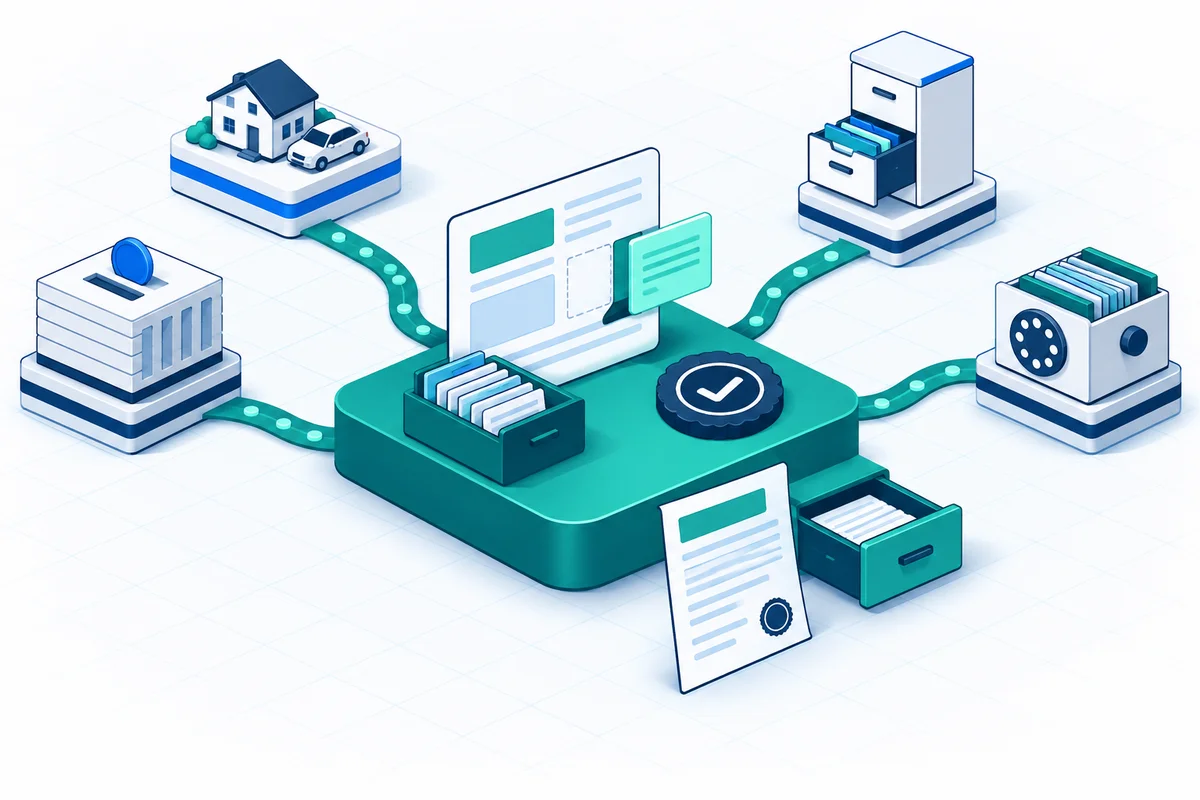
Many sources, one governed document
Agency data lives in many systems
Insurance Document Workflows Beyond the Agency Platform
Documents rarely begin and end inside one application. A realistic agency insurance document workflow looks more like a chain:
Each hop deserves scrutiny. Which events are urgent enough to justify synchronous generation (a certificate a client is waiting on) versus queued or scheduled batch generation (a renewal run or a mass mailing)? Which documents genuinely need human approval and which only need exception review? What happens when the trigger fires twice, when a required field is empty, when delivery bounces, or when a batch completes partially?
- Servicing event in EZLynx
- Validated trigger
- Data retrieval from the relevant systems of record
- Rules determine which template, clauses, forms, and jurisdictional language apply
- Assembly of the document or packet
- Optional review or approval
- E-signature where required
- Delivery by email, portal, or print
- Archive with searchable metadata
- Status and document reference written back so the agency team can see it in context
These unglamorous details determine whether automation holds up in month three. Idempotency keys stop duplicate certificates going out. Missing-data rules decide between blocking generation and routing to a queue. Reconciliation reporting confirms that every renewal letter the system intended to produce was actually produced, delivered, and filed.
How a Centralised Document Layer Complements Existing Capabilities
Agency platforms, EZLynx included, provide document and communication functionality. The point of a dedicated document automation layer is not that those capabilities are missing — it is that many agencies and brokerages run more than one system. An agency may use EZLynx alongside a separate accounting package, a carrier portal estate, a customer relationship management (CRM) system, a benefits system, or an additional management system inherited through acquisition. Acquisitive agencies in particular inherit template estates that nobody has rationalised.
Centralising the document layer means one template library, one brand standard, one clause repository, one approval model, and one audit trail serving multiple upstream systems. The same certificate template can be driven by data from whichever system holds the relevant book, rather than being rebuilt three times in three tools — the same principle behind automating document generation across enterprise systems.
This is one architectural option, not the only one. Some agencies are entirely happy producing routine correspondence natively and reserving a document layer for the complex, high-risk, or high-volume artefacts: commercial proposals, renewal packets, regulated notices, and anything with conditional wording that compliance must sign off.
The honest trade-off is that a document layer adds an integration and a governance discipline; it pays back when document variability, volume, or regulatory exposure is high, and less so when an agency produces a handful of simple letters.
Where Experlogix Document Automation Fits Around EZLynx

Experlogix Document Automation is deployed alongside existing insurance technology rather than in place of it, which is the relevant posture here: EZLynx continues to own agency management and rating, while the document layer handles generation, workflow, delivery participation, and content governance.
Several capabilities map directly onto agency document problems:
- Template Builder uses familiar Microsoft Word functionality to create templates with dynamic data fields pulled from connected systems, including jurisdiction-specific content, dynamic tables and graphics, and automatic language selection — which reduces the need to maintain separate template versions manually for every state, province, or region.
- Smart Forms supports customisable forms inside an automated workflow, so information that does not yet exist in the management system — supplemental underwriting questions, certificate holder details, client confirmations — can be captured with pre-configured business rules and then feed document generation directly, rather than arriving as an email that somebody retypes.
- Smart Flows provides the document flow automation layer that sequences generation, routing, and downstream steps.
- Content Manager acts as a repository inside Experlogix Document Automation that organises and governs digital assets in folders and nested folders, with collaboration features including comments, approvals, and change requests — useful for controlled clause and disclosure language.
- De Document Automation API allows document generation and automation to be embedded into other applications, with role-based API keys and an extensive library of API calls.
Experlogix Document Automation also offers out-of-the-box integration with major business platforms including Microsoft Dynamics 365, Salesforce, and NetSuite, and can connect to an unlimited number of data sources — relevant for agencies whose client data, accounting data, and marketing data do not live in the same place.
API integration as the architectural strength
For an agency platform such as EZLynx, application programming interface (API)-led integration is the right design, and a strong one. It is a one-time, well-scoped setup — one that AI-assisted tooling can help guide: agree the data contract, agree authentication and service identity, map the fields, define the triggers, and define the failure paths. From that point the connection carries ongoing architectural weight — handling spikes such as renewal runs and mass notices, supporting long commercial packets, and letting a single governed template estate serve multiple source systems. API-driven integration is also what makes it practical to source one document from several systems at once, which is precisely the case for a commercial proposal that needs rating output, client exposure data, and accounting terms in a single artefact.
The practical implication for IT leaders is reassuring: IT sets up and controls the integration, identity, environments, monitoring, and release process, then hands template and wording ownership to operations and compliance.
Business Ownership, Governance, and Audit Evidence
The strongest operational argument for a dedicated document layer in an agency setting is who ends up maintaining it. When a certificate wording change, a new disclosure requirement, or a rebrand requires a developer ticket, document changes move at the speed of the backlog. When templates are built on Word-based, low/no-code foundations, an operations manager or compliance lead can make the change, route it for approval, and publish it.
Governance should still be explicit:
- Versioning and effective dates so a document reproduced two years from now reflects the wording that applied at the time.
- Jurisdictional variants maintained as conditional content inside one template rather than as separate files per state, province, or region.
- Role-based access so who may edit, who may approve, and who may publish are distinct.
- Evidence showing which template version, which data, which approver, which delivery channel, and which retention rule applied to a given document.
That evidence is what turns document automation from a productivity tool into a defensible control, particularly for certificates, notices, and anything that could later be contested.
AI, Assistance, and the Limits of Autonomy
AI is increasingly useful in agency document work, and increasingly risky when applied without boundaries. The productive pattern is assistance and orchestration rather than decision-making.
Experlogix Document Automation includes a Smart Flows MCP (Model Context Protocol) server published for use in Microsoft Copilot Studio, enabling Copilot agents to discover which Smart Flows are available, understand what inputs are required to run them, and execute them in a structured, supported way with security boundaries and traceability. In an agency context, that means a service team member could ask an agent to start a renewal packet or a certificate workflow conversationally, while the workflow itself — data sourcing, template selection, approval routing, delivery — remains the governed process the business designed.
The governing principle holds: agents operate within parameters the organisation defines, actions are logged, and documents are traceable, with humans retaining control over where the boundaries sit. Coverage recommendations, eligibility, pricing, and anything resembling a regulated judgement stay with licensed people and authorised systems. AI earns its place by removing navigation, retyping, and assembly effort — not by deciding what cover a client should have.
Summary
EZLynx gives agencies a strong operational core for clients, policies, rating, and servicing. The document layer around it is where effort quietly accumulates — certificates, proposals, renewal packets, notices, and jurisdictional disclosures that each carry their own data sources, wording rules, and evidence requirements.
Three findings are worth carrying forward. First, decide ownership before tooling: source of truth, trigger, template, approval, delivery, archive, and write-back each need a named owner. Second, treat failure paths as first-class design work — duplicate triggers, missing data, partial batches, and delivery failures are where automation projects are actually judged. Third, put template and wording control in the hands of operations and compliance while IT retains integration, identity, and release control; that division is what keeps document change at business speed.
A reasonable next step for most agencies is small and specific: pick the one document type that causes the most rework — often certificates or commercial renewal packets — map its full lifecycle end to end, identify every system it touches, and use that single workflow to test whether a centralised, API-connected document layer earns its place before extending the pattern across the book.
Veelgestelde vragen
What role does EZLynx play, and where does document production begin?
EZLynx, part of the Applied Systems family, functions primarily as an agency management and client-servicing environment, with comparative rating used heavily in personal lines and a growing footprint in small commercial. In practice, that means EZLynx holds the authoritative record of who the client is, what policies they carry, which carriers wrote them, what the producer and account manager have done recently, and what the pipeline looks like.
Where does insurance document complexity arise around EZLynx?
Agency document work is deceptively varied. A single mid-sized commercial account can generate many distinct artefacts in a year, each with its own data sources and review expectations. Comparative quote summaries, coverage comparison grids, proposals with recommended and declined options, applications and supplemental questionnaires, and signed rejection or selection forms.
Which document workflows extend around EZLynx?
Documents rarely begin and end inside one application. A realistic agency insurance document workflow looks more like a chain: Each hop deserves scrutiny. Which events are urgent enough to justify synchronous generation (a certificate a client is waiting on) versus queued or scheduled batch generation (a renewal run or a mass mailing)?
How can Experlogix Document Automation complement EZLynx?
Agency platforms, EZLynx included, provide document and communication functionality. The point of a dedicated document automation layer is not that those capabilities are missing — it is that many agencies and brokerages run more than one system. An agency may use EZLynx alongside a separate accounting package, a carrier portal estate, a customer relationship management (CRM) system, a benefits system, or an additional management system inherited through acquisition.
Who should own document templates, approvals and governed changes?
The strongest operational argument for a dedicated document layer in an agency setting is who ends up maintaining it. When a certificate wording change, a new disclosure requirement, or a rebrand requires a developer ticket, document changes move at the speed of the backlog.