
Sapiens is a long-standing provider of core insurance software, with platform families covering property and casualty, life, pensions and annuities, reinsurance and workers’ compensation administration. If your organisation runs on Sapiens, the policy, billing and claims records are already in good order — but the documents that surround those records often are not. Policy packets, endorsement notices, claims correspondence, producer communications and jurisdictional notices tend to accumulate across templates, teams, output engines and side processes, each with its own change cycle and its own queue for IT or consulting help. Without a deliberate approach to Sapiens document automation, every new product variant, regulatory update or regional wording change becomes a development ticket rather than a business task, and operational agility quietly erodes.
TL;DR
- Sapiens administers the authoritative policy, billing, claims and benefit state. A governed document layer handles how that state becomes an accurate, compliant, branded, delivered and retained document.
- Document complexity in insurance rarely comes from formatting. It comes from jurisdiction, product and form-edition variation, effective dating, conditional clauses, nested schedules and data that lives in more than one system.
- Many insurers keep native Sapiens output where it is well suited and add a dedicated document automation platform for high-variation, multi-source or multi-platform document work. This is one architectural option, not the only one.
- Experlogix Document Automation is designed to sit alongside existing core systems. Its Template Builder uses familiar Microsoft Word functionality, it can connect to an unlimited number of data sources, and its API lets document generation be triggered from virtually any application.
- Decide early who owns data, triggers, templates, approvals, delivery evidence, archive and write-back. That ownership map matters more than any single feature comparison.
Happy shiny people. Insurance marketing loves the image of policyholders living their best lives, blissfully unbothered by the catastrophes their cover protects them against; a centralised document layer that lets the business own document automation accurately and quickly — without heavy ongoing IT labour — is how the insurance professionals behind the scenes start living their best lives too.
What Sapiens Owns, and What Sits Around It

Before deciding what belongs in a document layer, be precise about the boundary.
Keeping that boundary explicit is the single most useful architectural decision an insurer can make here, because it prevents the core platform from accumulating bespoke document logic that nobody wants to maintain at upgrade time.
A Sapiens core platform is the system of record for the transaction: the quote, the policy term, the endorsement, the premium, the invoice, the claim, the benefit or the pension entitlement. It holds the state, the rules that produced that state, and the audit of how the state changed. Nothing in a document strategy should blur that.
The document estate is a different concern. It covers which artefact is required at each lifecycle event, which approved wording and form edition applies, which data from which systems must appear, who approves it, how it reaches the recipient, what proves it was delivered, and how long it is retained.
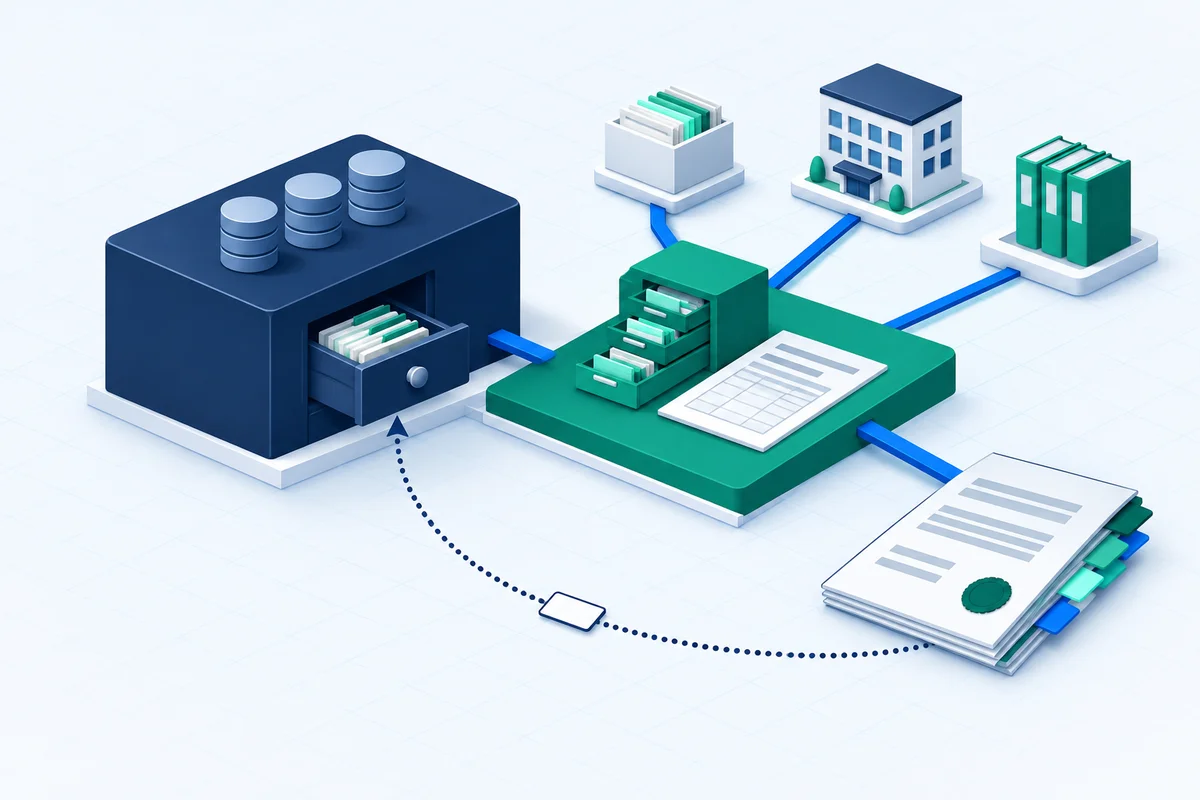
Those two concerns interact at a handful of well-defined points: an event occurs in Sapiens, a document process is triggered, data is retrieved, a document is produced, someone or something approves it, it is delivered and archived, and a status or reference is written back so the core record shows what happened.
Where Document Complexity Actually Emerges
Jurisdiction, product and edition variation
A commercial package policy issued across multiple states, provinces or regions is rarely one document. It is a packet: declarations, schedules, mandatory and optional endorsements, required notices and product disclosures, each selected by jurisdiction, product, coverage and effective date. Multiply that by brands, distribution channels and legacy books acquired over time, and the template estate grows faster than the team maintaining it.
The hard requirement is not simply producing today’s correct wording. It is reproducing a historical document with the form edition and effective-dated content that applied at the time — a routine demand in disputes, audits and regulatory reviews.
Data that is not simply printed as it arrives
Insurance document data is structured, nested and frequently needs interpretation before it is readable. Schedules of locations and vehicles must be unpacked into repeating tables. Limits and deductibles need conditional presentation. Premium breakdowns need calculated subtotals. Named-insured hierarchies need filtering and sorting. Benefit communications need lookups against plan configuration.
In many traditional set-ups, each of those behaviours is implemented in code or script by developers or consultants. That is precisely the work that drives long change cycles and makes a small wording request expensive.
Documents that need more than one system
Sapiens holds the policy or claim. The customer relationship record may live in a CRM such as Microsoft Dynamics 365 or Salesforce. Producer and commission context may live in a distribution or agency system. Licensed forms and clause content may come from an authoritative insurance content provider. Archive and retention may live in SharePoint, OpenText or another enterprise content management system.
A document that needs all of that is where a dedicated document layer usually earns its place, because it can assemble from multiple sources rather than forcing one system to become the staging area for everyone else’s data.
Volume that arrives in waves
Interactive, one-at-a-time generation is the easy case. The demanding cases are renewal cycles, mass endorsements following a rate or form change, catastrophe communications after an event, and long commercial schedules that run to hundreds of pages. These need to be designed and performance-tested deliberately, with batching, queueing, retry behaviour and reconciliation considered from the start.
One governed document layer beside Sapiens
1 · Sapiens event triggers a document
Document Workflows Across the Insurance Lifecycle
Around a Sapiens implementation, a useful way to scope work is by lifecycle stage.
Each of these is a candidate for the same question: does this document belong natively in Sapiens, or does it belong in a governed document layer that several systems can call?
- Before bind: applications, supplementary questionnaires, quote comparisons, proposals, subjectivity letters and binders. These are often collaborative and frequently involve brokers, so data capture quality matters as much as the output.
- At issuance: declarations pages, policy packets, master policies, evidence of coverage, certificates, ID cards and required notices. This is the highest-stakes assembly work, where form selection and effective dating must be provably correct.
- Mid-term: endorsements, cancellation and lapse notices, reinstatements, non-renewal notices and premium audit documentation. Mid-term changes are where variation and timing rules bite hardest.
- Billing: invoices, instalment schedules, premium increase notices, payment confirmations and collection correspondence, often with channel preferences per recipient.
- Renewal: renewal offers and packages, revised schedules, comparison summaries and producer renewal packets, typically concentrated into peak windows.
- Claims: acknowledgement letters, reservation-of-rights letters, status updates, settlement and denial correspondence, benefit explanations and closure letters. Experlogix automates the complete correspondence cycle for claims and other document-intensive processes, from initial claim receipt through status updates and resolution, with communications generated and delivered with appropriate personalisation.
- Compliance and reporting: regulatory notices, product disclosures, state, provincial or regional filing packages, audit reports and statutory reporting support.
- Producer and partner servicing: appointment and onboarding documentation, commission statements, agency communications and document exchange with third parties including reinsurers.
Native Core Output and a Dedicated Document Layer
Core insurance platforms, Sapiens included, ship with document and correspondence capabilities, and those capabilities handle a great deal of routine production perfectly well. The useful conversation is not whether native output exists; it is where the marginal cost of maintaining document logic inside the core exceeds the benefit.
The strongest argument for centralisation is rarely a single document type. It is the estate effect: one governed template library, one clause set, one approval model and one set of delivery and archive rules serving Sapiens alongside other administration platforms, agency systems and back-office applications. That is what keeps brand, wording and compliance consistent when an insurer runs more than one core system — which, after acquisitions and multi-line growth, most do.
Insurers commonly keep documents native when they are tightly coupled to core transactions, low in variation, stable in wording, and populated entirely from core data.
Insurers commonly move documents into a dedicated layer when they are high in jurisdictional or product variation, assembled from several systems, subject to frequent compliance-driven wording changes, shared across more than one administration platform, or dependent on business users making changes quickly.
Treat this as an option to evaluate against your own estate rather than a default conclusion.
Integration Architecture: An Enabler, Not a Project

API-led integration is the natural way to connect a core platform to a document layer, and it is a strength rather than a compromise. The Experlogix Document Automation API is designed for exactly this: a flexible interface with role-based API keys and an extensive library of API calls that lets teams implement document generation and automation capabilities inside their own applications and workflows. Experlogix Document Automation can connect to an unlimited number of data sources, and offers out-of-the-box integration with major business platforms including Microsoft Dynamics 365 and Salesforce.
Practically, the integration work is a one-time design effort that then carries a great deal of ongoing load. Worth defining up front:
- Triggers. Which Sapiens events initiate generation, and whether each should be synchronous (an agent is waiting), queued (a packet in progress), scheduled (nightly notices) or batched (renewal runs).
- Data contract. The fields, nested structures, data types, required-versus-optional rules and schema-change process. Insurance data is nested; the contract should say how arrays, calculations and lookups are handled rather than leaving it to template authors.
- Identity and access. Service identities for system-to-system calls, role-based access for human users, and separation between template authoring, approval and production release.
- Failure handling. Idempotency for duplicate triggers, retry policy, behaviour on missing data, partial-batch recovery, delivery-failure handling and reconciliation reporting.
- Write-back. What returns to Sapiens: document reference, version, status, delivery evidence and archive location, so the core record remains the place where staff look first.
- Observability. Monitoring, alerting and the evidence trail that proves which template, data, approver, signature, channel and retention rule applied.
Document workflow also usually touches adjacent platforms — Microsoft Power Automate or ServiceNow for orchestration, DocuSign, Adobe Acrobat Sign or OneSpan Sign for signature, and SharePoint, OpenText or Hyland for archive. Experlogix integrates with storage and e-signature tooling so documents are routed, signed and warehoused without manual uploading or re-keying.
Security and governance sit alongside this rather than after it. Experlogix meets requirements for SOC 2 compliance and follows industry guidance including NIST and OWASP for security practice.
Set up well by IT once, this architecture lets the business own day-to-day document change — which is the whole point.
Business Ownership and Reduced Dependency on Developers
The operational argument for a dedicated document layer is ownership. Compliance and operations teams know what the wording must say; they should not need a development cycle to say it.
De Experlogix Template Builder uses the same functionality as Microsoft Word, so business users can build templates without coding knowledge, using software they already know. Templates can embed jurisdiction-specific content, dynamic data fields pulled directly from connected systems, dynamic tables and graphics, and automatic language selection — which reduces compliance risk while removing the need to maintain separate template versions by hand.
Smart Forms extend the same thinking upstream. A workflow can issue an email containing a form link, and form completion can trigger document generation, which is useful where data needed for a document does not yet exist in any system — supplementary underwriting information, claims declarations, or broker-completed application detail. Pre-configured business rules adapt each form to the customer's situation, improving data accuracy while shortening completion time.
Ownership still needs guard-rails. A workable model gives operations and compliance control over wording, clause libraries and approvals; gives product control over jurisdiction, form edition and effective-date decisions; and keeps IT in charge of integration, identity, environments, monitoring and release. Collaboration features such as versioning, track changes and commenting support review without exporting the process into email threads.
The honest trade-off: centralising templates creates a shared asset that needs stewardship. Someone must own naming conventions, clause reuse, retirement of superseded editions and testing before release. Insurers that skip this simply relocate their template sprawl.
AI, Governance and Human Oversight

AI is reshaping insurance document workflows, but its value depends on the quality of the process it is applied to. AI bolted onto immature processes adds complexity rather than productivity, and in insurance every AI-touched policy, claim or customer communication carries compliance implications — explainability, auditability and data governance are the conditions under which AI can be deployed at all.
Within that framing, there are sensible document-centred applications: AI assisting template and workflow configuration, suggesting content from approved libraries, supporting document review, and accelerating the set-up work that previously required specialist help.
There is also the agent-initiated pattern. Where staff interact with an organisation's AI assistant and ask for a document or a document workflow, Experlogix Document Automation can act as the governed execution layer behind that request — selecting approved templates, sourcing data from the right systems of record, routing approvals and producing compliant output. The addition of an MCP (Model Context Protocol) server, the emerging standard that lets AI agents connect to existing systems in a structured, auditable way, is what makes that connection governable rather than improvised.
The governance position should be unambiguous: agents operate within parameters the insurer defines, every document generated is traceable, every agent action is logged, and regulated judgement — underwriting, pricing, coverage, eligibility and claims decisions — stays with authorised people and systems. AI helps produce and orchestrate documents; it does not decide the insurance.
Summary
For insurers running Sapiens, the productive question is not whether the core platform can produce documents. It is where document work should live so that the business can change it quickly, compliance can prove it is correct, and IT can support it without a permanent backlog.
The key findings are straightforward. Sapiens should remain the authoritative record of the policy, billing, claim or benefit. Documents with high jurisdictional and product variation, multi-system data needs, frequent compliance-driven wording changes, or relevance across more than one platform are the strongest candidates for a centralised, governed document layer. Experlogix Document Automation is built to sit alongside existing core investments rather than replace them, with Word-based template authoring for business users, connectivity to an unlimited number of data sources, a flexible API for triggering generation from virtually any application, and workflow, delivery, e-signature participation and archive integration around the output.
Reasonable next steps are practical ones. Inventory your document types by lifecycle stage and score each for variation, data sources, change frequency and volume profile. Draw the ownership map for data, triggers, templates, approvals, delivery evidence, archive and write-back. Define the data contract and failure-handling rules before you design templates. Then pilot with one genuinely complex, high-variation document family — a commercial policy packet or a claims correspondence set — and measure how quickly your own operations and compliance teams can make a wording change end to end, because that single number tells you more about your document architecture than any feature list will.
Veelgestelde vragen
What role does Sapiens play, and where does document production begin?
Before deciding what belongs in a document layer, be precise about the boundary. Keeping that boundary explicit is the single most useful architectural decision an insurer can make here, because it prevents the core platform from accumulating bespoke document logic that nobody wants to maintain at upgrade time.
Where does insurance document complexity arise around Sapiens?
A commercial package policy issued across multiple states, provinces or regions is rarely one document. It is a packet: declarations, schedules, mandatory and optional endorsements, required notices and product disclosures, each selected by jurisdiction, product, coverage and effective date. Multiply that by brands, distribution channels and legacy books acquired over time, and the template estate grows faster than the team maintaining it.
When is native document output enough alongside Sapiens?
Core insurance platforms, Sapiens included, ship with document and correspondence capabilities, and those capabilities handle a great deal of routine production perfectly well. The useful conversation is not whether native output exists; it is where the marginal cost of maintaining document logic inside the core exceeds the benefit.
How should a governed document layer connect with Sapiens?
API-led integration is the natural way to connect a core platform to a document layer, and it is a strength rather than a compromise. The Experlogix Document Automation API is designed for exactly this: a flexible interface with role-based API keys and an extensive library of API calls that lets teams implement document generation and automation capabilities inside their own applications and workflows.
Who should own document templates, approvals and governed changes?
The operational argument for a dedicated document layer is ownership. Compliance and operations teams know what the wording must say; they should not need a development cycle to say it. The Experlogix Template Builder uses the same functionality as Microsoft Word, so business users can build templates without coding knowledge, using software they already know.