If your team sells multi-year agreements with increasing quantities, escalating rates, or mid-term additions, you already know that ramp deals are where quoting math gets fragile. In Salesforce CPQ, ramps, co-terming, and proration are usually handled through a mix of segmented subscription lines, custom price rules, and Quote Calculator Plugin (QCP) code that only a few people understand. With Salesforce CPQ now end of sale and no longer receiving meaningful new feature development, it is a reasonable time to ask whether your ramp and multi-year pricing logic should stay where it is. This article explains what correct date math requires, where common configurations break, and how to evaluate an alternative without overstating the problem.
TL;DR
- Ramp deals are multi-year agreements where price, quantity, or both change by period. Getting them right depends on accurate date math: term boundaries, proration, co-terming, and partial-year pricing.
- Salesforce CPQ can model ramps through segmented subscription lines and price rules, and it does this acceptably for moderate complexity. Difficulty grows when ramps combine with mid-term amendments, mixed revenue types, and non-calendar term boundaries.
- Salesforce CPQ is end of sale, not end of life. Existing customers can keep using it, renew, add users, and receive support. There is no announced end-of-life date, so there is no forced timeline for changing ramp logic.
- The practical trade-off: keep refining custom ramp calculations in a product that is no longer being developed, reimplement on Revenue Cloud Advanced (RCA), or keep Salesforce CRM and replace the quoting layer.
- Bottom line: inventory your real ramp scenarios first, express them as test cases with explicit dates, and make any CPQ you evaluate reproduce them exactly before you discuss anything else.
What a Ramp Deal Actually Requires From CPQ
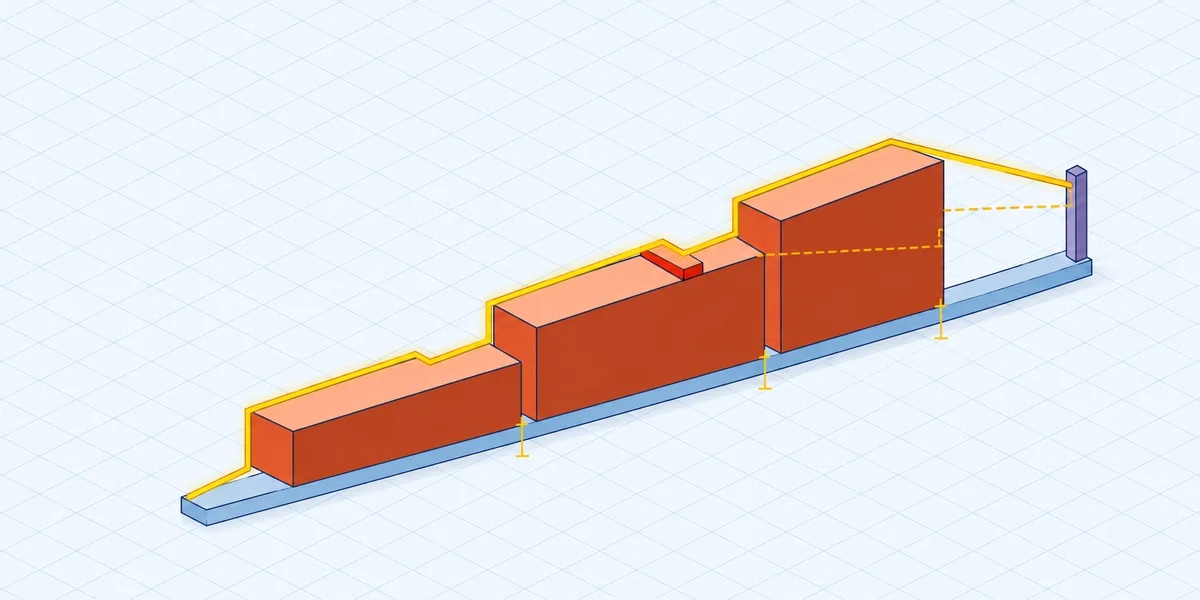
A ramp deal is a single agreement whose commercial terms change across the term, and quoting it correctly is a date-arithmetic problem before it is a pricing problem. A three-year contract might start at 200 users in year one, grow to 350 in year two, and 500 in year three, with a different unit price for each segment. Salesforce CPQ customers typically represent this as segmented subscription lines tied to period boundaries.
Correct ramp pricing depends on several calculations working together:
- Segmentation: splitting the term into periods with their own quantity and rate.
- Proration: calculating the charge for any period shorter than a full billing cycle, using the correct day count or monthly convention.
- Co-terming: aligning a new or added subscription to an existing contract end date so everything renews together.
- Partial-year pricing: pricing a stub period created by a mid-term start, an amendment, or a co-term alignment.
- Totals: rolling segments into annual contract value and total contract value that finance, sales, and the customer all read the same way.
Each of these is simple alone. The errors appear where they interact, usually when a customer adds product in month seven of year two and expects it co-termed, prorated, and priced at the ramp rate that applies to that segment.
Where Ramp and Multi-Year Pricing Get Hard in Salesforce CPQ
Salesforce CPQ handles standard ramp pricing patterns, and for subscription businesses with clean annual terms it is often sufficient. The strain shows up in three places.
Custom calculation logic accumulates
Non-standard proration conventions, uplift formulas, and co-terming rules are frequently implemented in the Quote Calculator Plugin or in layered price rules. That code works, but it becomes institutional knowledge held by a small group or an external consultant. Every change to a ramp policy becomes a development and regression-testing exercise rather than a configuration change.
Amendments compound the date math
A ramp quote that is correct at signature can drift after two amendments. Mid-term upgrades, downgrades, and co-termed additions each create new partial periods. When amendment logic and segmentation logic are both partly custom, reconciling what the customer owes in a given month takes manual effort.
The same date math carries into the next term. When the final ramp segment becomes the starting point for a renewal, your CPQ also needs to carry forward prior pricing at renewal instead of making someone rebuild it by hand.
Mixed revenue on one agreement
Many enterprise agreements are not purely subscription. They combine equipment, installation labor, professional services, support contracts, and recurring or usage-based charges. Salesforce CPQ's subscription-first model handles the recurring portion well. The harder part is carrying one-time, recurring, service and usage charges on one quote across a ramped multi-year term, and that blend tends to push teams into spreadsheets for the summary math.
None of this means Salesforce CPQ is failing. It means the design is optimized for a certain class of subscription quoting, and ramp complexity beyond that class costs you custom code.
Your Three Realistic Paths
Because Salesforce CPQ is end of sale rather than end of life, you have time to choose deliberately. Salesforce stopped selling it to new customers in March 2025. Existing customers can continue to use, renew, and expand it with support, and no end-of-life date has been announced. Strategic investment has moved to Revenue Cloud Advanced, now part of Agentforce Revenue Management.
- Stay on Salesforce CPQ. Sensible if your ramp structures are stable, your customizations are documented, and your admins can maintain them. You are accepting that ramp and multi-year pricing capabilities will not materially improve.
- Reimplement on Revenue Cloud Advanced. Salesforce describes a different data model and configuration approach, so this is a reimplementation, not an upgrade. It makes sense if you want a broader revenue platform and are prepared to redesign catalog, pricing, and lifecycle logic.
- Keep Salesforce CRM and replace the quoting layer. Appropriate when the CRM is working fine and the quoting engine is the constraint.
Be honest about fit. If your catalog is small, your terms are uniform annual subscriptions, and ramps are rare, a replacement project is hard to justify.
How Experlogix CPQ Approaches Multi-Year and Ramp Pricing
Experlogix CPQ is designed to keep Salesforce CRM as the system of record while it handles the pricing and configuration work. Sales users configure, price, and quote without leaving Salesforce, in the account and opportunity context they already know. Experlogix reads from Salesforce and writes back enriched configuration details, pricing calculations, and approval status in real time. It can write to standard or custom Salesforce objects without a separate middleware layer to maintain. This matters for ramp deals because the agreement's economics stay attached to the CRM record. They do not live in a replicated copy that has to be reconciled.
On the pricing side, Experlogix supports list, contract, and tiered pricing structures, and it applies region-specific rules, currency conversions, and volume-based breaks automatically. One quote can carry one-time equipment, recurring subscriptions, usage-based fees, and multi-year services and support. Each line keeps its own tiers, contract terms, and regional rules, and those are applied automatically. Margin stays visible across the whole bundle as well as on each line. For ramped solution deals that combine hardware, labor, and recurring revenue, that single-quote treatment removes a common source of manual summary math.
Pricing and discount rules are evaluated in real time during configuration. Standard deals pass through, and exceptions route automatically to the right approvers. Discount floors, ceilings, and stacking rules are defined in advance. Because Experlogix is a low-code platform, changes to a ramp or uplift policy are more likely to be an administrative task than a development project. Special pricing agreements are applied automatically, and each quote records which agreement it used. That helps when a ramped agreement is governed by a negotiated master arrangement.
What this does not do is remove the need for you to define your own conventions. Day-count methods, uplift rounding, and co-term alignment rules are business policy decisions. Any CPQ will only be as accurate as the policy you encode in it.
The Bottom Line on Ramp Deals and Multi-Year Pricing
Ramp deals expose the quality of a CPQ's date math more than almost any other scenario. Salesforce CPQ can model ramp pricing, proration, and co-terming. For stable, subscription-centric agreements, it continues to do so under full support. The cost shows up when amendments, partial-year pricing, and mixed revenue types stack on top of each other: more custom calculation logic, more dependence on specialists, and more manual reconciliation.
You are not under time pressure. End of sale is not end of life, renewals and user additions remain available, and no end-of-life date has been announced. That gives you room to judge each option on three questions:
- Can your own team configure and maintain ramp segments, proration conventions, and co-term alignments?
- Does the authoritative record stay in Salesforce CRM?
- Can a single quote carry one-time, recurring, service, and usage charges with totals that finance trusts?
Organizations that get this right spend less time rebuilding quote math by hand and more time on the commercial conversation. Their quotes, contracts, and invoices also match.
Start with one concrete step. Pull your five most complicated ramp agreements from the last year. Write out each one as a dated test case, including every amendment and co-term event, and calculate the expected result independently. That set of golden quotes becomes the objective standard for judging your current Salesforce CPQ configuration and any alternative you consider.
Veelgestelde vragen
What is a ramp deal in CPQ?
A ramp deal is a single multi-year agreement in which quantity, price, or both change by period. A typical example is a three-year contract that starts at 200 users in year one, grows to 350 in year two, and reaches 500 in year three, with a different unit price for each segment. Quoting it correctly depends on segmentation, proration, co-terming, partial-year pricing, and consistent annual and total contract value.
How do co-terming and proration work in multi-year CPQ quotes?
Co-terming aligns a new or added subscription to an existing contract end date so everything renews together. Proration calculates the charge for any period shorter than a full billing cycle, using an agreed day-count or monthly convention. In a ramp deal, the two combine: a mid-term addition creates a stub period that should be prorated and priced at the ramp rate for the segment it falls in.
Why do ramp quotes drift after amendments?
Each mid-term upgrade, downgrade, or co-termed addition creates new partial periods on top of the original ramp segments. When amendment logic and segmentation logic are both partly custom, as they often are with Quote Calculator Plugin code or layered price rules, the amended quote can diverge from what was originally signed. Working out what the customer owes in a given month then takes manual reconciliation.
How should you test ramp pricing in a new CPQ?
Use your own real agreements rather than vendor demo scenarios. Select your most complicated ramp deals and write each one as a dated test case that includes every amendment and co-term event. Calculate the expected results independently, then require any CPQ you evaluate, including your current Salesforce CPQ configuration, to reproduce those golden quotes exactly, down to segment pricing, prorated stub periods, and contract totals.
Put your hardest ramp deal to the test