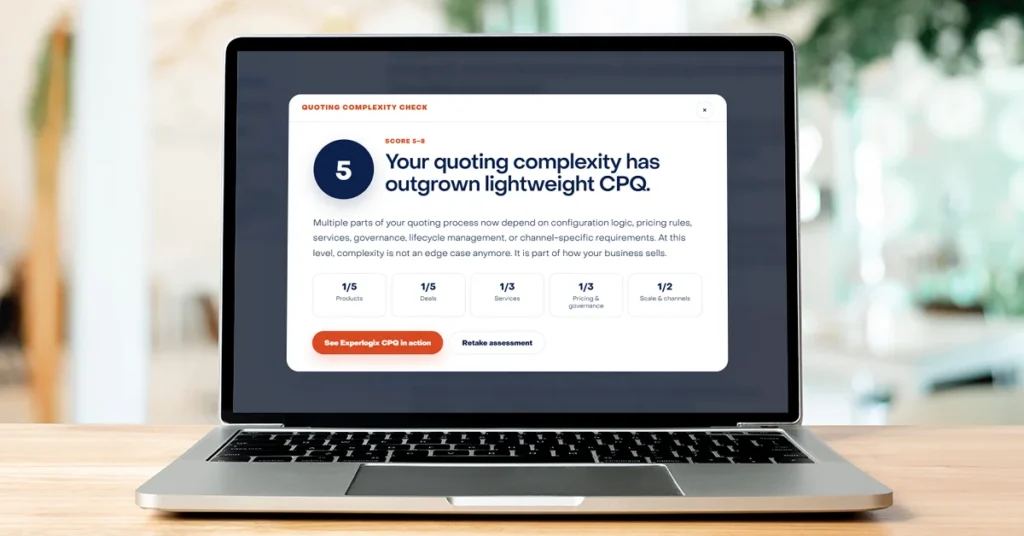
Salesforce CPQ was built to remember a deal as a subscription: a term, a contract, assets, amendments, and renewals. That model works well until a quote also has to carry equipment, installation labor, a multi-year service plan, and a usage-based component that nobody can forecast precisely. If you run Salesforce CPQ, you have probably seen the result. The system handles the subscription part well and makes you work for everything else. This article explains why that happens, what it costs you operationally, and how to decide whether your quoting layer still fits the way you sell.
TL;DR
- Salesforce CPQ (configure, price, quote) was designed around a subscription-first data model. Terms, contracts, assets, amendments, and renewals are central to how it calculates and records a deal.
- That design works well for recurring software and moderate-complexity bundles. It struggles when one quote has to carry one-time equipment, configured products, scoped labor, project milestones, subscriptions, and usage-based pricing together.
- Salesforce stopped selling Salesforce CPQ to new customers in March 2025. This is end of sale, not end of life. Existing customers can keep using it, renew, add users, and get support, and no end-of-life date has been announced. Investment has moved to Revenue Cloud Advanced (RCA), now part of Agentforce Revenue Management. Moving to it is a reimplementation, not an upgrade.
- You have three options. You can stay and live with the workarounds. You can redesign on Revenue Cloud Advanced. Or you can keep Salesforce CRM as your system of record and replace only the quoting layer with a CPQ that handles subscriptions and hybrid revenue equally well.
- Bottom line: test your hardest real solution quote against whatever you keep or buy, not a demo catalog. If reps rebuild that quote in spreadsheets today, the product model is the problem, not the reps.
Why Salesforce CPQ Feels Subscription-First
Salesforce CPQ is organized around the subscription lifecycle, and that shapes everything downstream. Its core objects express a deal as subscription terms, contracted assets, amendments, and renewals, with proration and date math applied to recurring lines. For a company selling recurring software with some professional services attached, this is a real strength. Renewals carry forward, amendments net correctly, and the chain from quote to contract stays consistent.
The friction starts when the quote is not mainly a subscription. A configured machine, a scoped installation crew, a project with milestones, and a consumption-metered service each behave differently from a recurring line with a fixed term. They have different units, margin structures, and approval sensitivities. They also feed different downstream systems: manufacturing and ERP (enterprise resource planning) on one side, billing and revenue recognition on the other.
Where the design constraints show up
Be precise about what actually breaks, because vague criticism does not help you build a business case.
- Managed package architecture. Salesforce CPQ ships as a managed package with a fixed object model. You extend it with custom fields, flows, and Apex, but you cannot change how a line item is defined. Labor, project, and usage lines usually end up modeled as something they are not.
- Quote Calculator Plugin (QCP) dependence. Custom pricing math for mixed models often ends up in QCP JavaScript. Few admins want to maintain that code, and it is a significant item in any migration inventory.
- Rule maintenance at scale. Product rules, price rules, and constraint rules multiply as hybrid offers multiply. Nested bundles make this worse, and large quotes with deep bundle trees run into platform performance problems and governor limits.
- Specialist dependence. Once the logic lives in rules plus code, routine changes such as a new service tier or a revised usage band need a consultant or developer rather than a business administrator.
- Limited new development. Salesforce CPQ is no longer receiving meaningful new feature work, so gaps in mixed-model quoting are unlikely to close if you stay where you are.
None of this means Salesforce CPQ has stopped working. It means the product was built around subscriptions, and your deals no longer are.
What Hybrid Revenue Actually Demands From a Quote
Hybrid revenue means one deal combines several pricing behaviors, such as one-time, recurring, usage-based, and service or project revenue. Quoting it requires a quote that can hold all of them and still produce one coherent commercial document. In practice, that means four things.
One: multiple pricing models on one quote. One-time plus recurring is the minimum. Usage-based pricing is where a subscription-first model is most exposed. The quote has to show committed amounts, overage bands, and estimated consumption without treating them as subscriptions. For the full set of requirements, see this guide to quoting products, services and subscriptions in one deal.
Two: labor and project scoping. Professional services sales often combine custom engagements, multi-tiered pricing, bundled deliverables, and subscription- and project-based pricing in the same deal. Hours, roles, rates, and milestones are not SKUs. Treating them as SKUs is where quoting accuracy starts to slip.
Three: margin visibility across the bundle and on each line. A hardware line at thin margin may be deliberate because the attached service contract carries the deal. If your CPQ cannot show both views, people make discount decisions without seeing the full margin picture. Servitization, which means selling outcomes rather than units, creates exactly this problem. It brings multiple pricing models, labor scoping, fragmented margins, longer contract lifecycles, and additional finance requirements.
Four: a clean handoff. The same configured solution has to reach ERP as something that can be built and delivered. It also has to reach the customer as a document that matches what was approved.
Three Honest Paths Forward
Salesforce is not forcing a move. Choose based on how far your revenue model has moved away from fixed-term subscriptions. Each path is summarized below; for a detailed side-by-side, see the full comparison of Salesforce CPQ, Revenue Cloud and Experlogix.
Stay on Salesforce CPQ for now
This is a legitimate choice. You can renew, add users, and receive support. Change may cost more than the friction it removes if your catalog is moderate, your bundles are shallow, and hybrid lines are occasional rather than central to how you sell. Use the time well. Document your rules and inventory your QCP customizations. Then set a trigger for revisiting the decision, such as a new product line, a usage-based offer, or hitting a performance limit.
Reimplement on Revenue Cloud Advanced
Revenue Cloud Advanced is where Salesforce's investment now sits, and it uses a different data model and configuration approach. Salesforce itself frames the move as a redesign, not a direct configuration migration. This path makes sense if you want one vendor's platform across CPQ, billing, and revenue management, and you have the budget for a reimplementation. Scope it as a redesign with full regression testing, not an upgrade.
Keep Salesforce CRM and replace the quoting layer
The third option is often overlooked. You leave Salesforce CRM as your system of record and change only the layer that is failing, which limits how much of your stack the change affects. Accounts, opportunities, forecasting, and reporting stay where they are. What changes is how a solution gets configured, priced, approved, documented, and handed off.
How Experlogix CPQ Approaches Mixed-Revenue Quoting
Experlogix CPQ is designed for quotes like these. One-time equipment, recurring subscriptions, usage-based fees, and multi-year services and support can sit on a single quote. Each line keeps its own tiers, contract terms, and regional rules, and margin is visible for the whole bundle and for each line.
Pricing follows defined policy rather than being negotiated line by line. You can configure list, contract, and tiered pricing structures. Region-specific rules, currency conversions, and volume-based breaks apply automatically. You can also define discount floors, ceilings, and stacking rules. Standard deals pass instantly, exceptions route automatically to the right approvers, and every pricing decision is logged. Special pricing agreements (SPAs) are applied automatically, in concert with your CRM, and each quote records which agreement it used.
Configured products are where a subscription-shaped model has the least to offer. The Experlogix rules engine checks thousands of options and dependencies in real time. It then passes complete bill of materials (BOM), work breakdown structure (WBS), and routing data to ERP, which covers configure-to-order and engineer-to-order products.
Experlogix CPQ works with both Salesforce and Microsoft Dynamics 365. In Salesforce, it runs as an embedded CPQ experience. Reps configure, price, and quote inside the Salesforce CRM interface they already know. Experlogix reads data from Salesforce and writes configuration details, pricing calculations, and approval status back to it in real time. It can write to standard or custom Salesforce objects without developers. Cloud Connect synchronizes quotes, orders, and approvals across CRM and ERP without custom code. It replaces the middleware and point-to-point integrations that tend to break when a platform updates.
This matters for hybrid revenue. Some CPQ tools work by copying CRM data into a separate platform and syncing it back. Avoiding that copy-and-sync step also avoids stale or mismatched records, duplicate records, reconciliation work, and the integration upkeep that comes with storing deal data in more places. Administration is low-code, so adding a service tier or a usage band is a configuration task rather than a development ticket.
Where another path fits better
If your catalog is small and your pricing is published, a lighter Salesforce-native tool will cost less and do the job. If you are a pure self-service SaaS business with no configured products, no labor, and no ERP handoff, an industrial-grade configurator is more capability than you need. And if your organization has already committed to a Revenue Cloud Advanced reimplementation with funding and a plan, finishing that work is usually better than changing direction mid-project.
The Bottom Line on Moving Beyond Subscription-First Quoting
Salesforce CPQ is end of sale, not end of life. You can renew it, add users to it, and keep running on it while you decide. What you should not expect is for its subscription-first data model to adapt to the way you now sell. Meaningful feature development has stopped, and Salesforce's investment has moved to Revenue Cloud Advanced, which requires a reimplementation rather than an upgrade.
Five questions will guide the decision:
- How much of your revenue now comes from hybrid deals rather than straightforward recurring terms?
- How many of your quotes need a spreadsheet, a QCP customization, or a specialist before they can be sent?
- How deep do your bundles go, and how large do your quotes get?
- How much of your pricing and rule logic could a business administrator change tomorrow without filing a ticket?
- Where does the configured solution need to land, whether ERP, a contract, or a customer document, and does it arrive intact?
When teams match their quoting layer to their actual revenue model, they tend to see the same benefits:
- Each quote comes from one calculation under one set of pricing rules, instead of several that have to be reconciled.
- Approvals route on thresholds rather than relationships.
- Documents match what was approved.
- Admins can handle a pricing change without a project.
These are process improvements, not predictions about your specific numbers.
A practical next step is to take your three hardest recent deals, the ones with equipment, labor, subscriptions, and usage on the same quote. Map every line to how your current system actually stores it. Note each place where a rep, an ops analyst, or a spreadsheet had to step in. That map shows whether your quoting problem is a configuration backlog or a model mismatch. It is also the most useful thing to bring into any discussion about staying, redesigning, or replacing.
Veelgestelde vragen
Is Salesforce CPQ subscription-first?
Yes, in its data model. Salesforce CPQ stores a deal as subscription terms, contracted assets, amendments, and renewals, with proration and date math built around recurring lines. It can quote one-time products and services, but labor, project milestones, and usage-based lines often have to be modeled as something they are not. That usually takes extra rules, custom fields, or QCP code.
How should CPQ handle usage-based pricing on a quote?
Usage-based pricing should be its own pricing behavior on the quote, not a disguised subscription. The quote needs to show committed amounts, overage bands, and estimated consumption alongside one-time and recurring lines. It should keep margin visible across the bundle and on each line, and pass that structure cleanly to billing.
What is hybrid revenue in CPQ?
Hybrid revenue is a revenue model where a single deal combines several pricing behaviors. These can include one-time equipment, recurring subscriptions, usage-based fees, multi-year services, and scoped labor or project work. A CPQ that supports hybrid revenue can price all of them on one quote and produce one commercial document. It does this without spreadsheets or custom code to reconcile the pieces.
How do you tell a configuration backlog from a CPQ model mismatch?
Map your three hardest recent deals line by line against how your current system stores them. If the friction comes from rules or templates nobody has had time to update, it is a configuration backlog. You can fix that by documenting your rules and simplifying the configuration. If labor, usage, or project lines need workarounds every time because the data model cannot represent them, it is a model mismatch. That kind of problem points toward redesigning on Revenue Cloud Advanced or replacing the quoting layer.
Put your hardest hybrid quote to the test