
If your agency runs on HawkSoft, you already know what it does well: it keeps client, policy, carrier and servicing history in one place so that your team can answer a question without hunting through four systems. What it cannot do on its own is absorb every document obligation that an independent agency carries — proposals, certificates of insurance, summaries of insurance, renewal packets, binder letters, cancellation and non-renewal notices, producer agreements, commission statements and the long tail of client correspondence that varies by carrier, by line of business, and by state, province or region. When those documents are produced by copy-and-paste, bespoke merge files or a spreadsheet of “approved” wording that only one person maintains, document work quietly becomes the slowest part of an otherwise efficient agency.
TL;DR
- HawkSoft is the agency’s system of record for clients, policies, servicing history and workflow; it is not designed to be the enterprise-wide document factory for every branded, jurisdiction-specific, multi-source document an agency produces.
- Document complexity in an agency is driven by variation — carrier, line of business, state/province/region, coverage structure, client size and brand — which is exactly where manual assembly and one-off templates start to fail.
- For HawkSoft document automation, a dedicated document layer such as Experlogix Document Automation can sit alongside HawkSoft, drawing data from HawkSoft and other systems to produce governed documents, route approvals, deliver, archive and log evidence.
- API-led integration is the architectural foundation: a one-time, well-specified connection that supports both interactive, single-document requests and high-volume renewal or notice runs.
- The decision that matters is ownership: which system owns the data, the trigger, the template, the approval, the delivery evidence and the archive.
Happy shiny people. Insurance marketing loves the image of policyholders living their best lives, blissfully unbothered by the catastrophes their cover protects them from — and a centralised document layer that lets the business configure and maintain document automation accurately, quickly and without heavy ongoing IT labour means the insurance professionals behind the scenes get to live their best lives too.
What HawkSoft Owns in the Agency Lifecycle
An agency management system (AMS) is the operational spine of an independent agency. HawkSoft holds the client file: household or commercial account details, policy records across carriers, servicing activity, notes and logs, attachments, and the servicing workflow that tells a CSR what needs doing today. It is also the system most agencies treat as authoritative when a regulator, a carrier auditor or an errors-and-omissions reviewer asks what the agency knew and when.
Understanding that boundary is the key to any sensible conversation about HawkSoft document automation. The AMS is the source of truth for client and policy context. It is not, by design, an enterprise document composition engine for every artefact an agency produces, nor is it the natural home for brand governance across multiple agency locations, acquired books or specialised programmes.
Most agencies also run other systems around the AMS: comparative raters and quoting tools, carrier portals, a CRM or marketing platform, accounting software, e-signature services such as DocuSign or Adobe Acrobat Sign, and a document store such as Microsoft SharePoint or an enterprise content management (ECM) system. Each one holds a slice of the data that a complete, client-ready document actually needs.
Where Document Complexity Emerges Around an AMS

Agency documents look simple until you examine the variation hiding inside them.
Each of those document families has a different owner, a different approval expectation and a different retention rule. That is the practical argument for treating documents as their own governed layer rather than as a by-product of whichever system happened to trigger them.
- Variation by jurisdiction.
Required notices, cancellation language, surplus lines disclosures and consumer notices differ by state, province or region. A template estate that does not model jurisdiction as a first-class variable will accumulate near-duplicate files, and near-duplicates are where outdated wording survives.
- Variation by carrier and line of business.
A commercial proposal for a contractor with a controlled schedule of locations, a personal lines renewal summary and a benefits enrolment communication share almost no structure. Conditional logic, schedules, repeating sections and coverage comparison tables are the norm, not the exception.
- Variation by data source.
The client and policy record may live in HawkSoft, premium figures may come from a rater or carrier quote, a loss run may come from a carrier, a payment plan may come from accounting, and the agency’s approved coverage wording may come from a licensed content library. Documents rarely print source data as-is. Values must be filtered, calculated, grouped, formatted and sometimes unpacked from nested structures before they belong on a page.
- Variation by volume profile.
Renewal season, mass endorsement pushes and catastrophe communications behave nothing like a single proposal generated during a client meeting. Interactive generation needs to be fast; batch generation needs to be reliable, resumable and reconcilable.
- Variation by brand.
Agencies that have grown by acquisition often maintain multiple brands, signature blocks, licensing footers and letterhead variants over a single operational platform.
Documents Agencies Typically Produce Around HawkSoft
- Pre-bind: submission packets, applications, loss summaries, proposals and coverage comparisons.
- At bind: binder letters, evidence of property, auto ID cards, certificates of insurance and finance agreements.
- In force: endorsement confirmations, summaries of insurance, schedules of locations or vehicles, claim acknowledgement and status letters.
- Renewal and billing: renewal proposals, premium change explanations, invoices, payment reminders, cancellation and reinstatement notices.
- Compliance and governance: required notices, disclosures, E&O documentation, carrier appointment and producer agreements, audit support packets.
One renewal packet, many sources
HawkSoft stays the system of record. The document layer assembles.
Native Output Versus a Governed Document Layer
Agency management systems, raters and carrier portals all produce documents, and nothing here suggests otherwise. The useful question is not "can the platform generate a document?" but "where should a particular document be governed?"
A reasonable rule of thumb:
- Native output
Keep native the documents that are tightly coupled to a single system's own transaction and require no outside data — system-generated forms, standard acknowledgements, and anything a carrier or regulator expects to originate from that specific platform. - Governed document layer
Move to a governed document layer the documents that combine data from several systems, carry controlled or jurisdiction-specific wording, need business approval before release, must be reproduced later exactly as issued, or are branded assets that the agency wants consistent across every location.
This is one architectural option among several, not a universal prescription. Some agencies are perfectly well served by native output plus disciplined manual review. The calculus changes when the agency grows, acquires, adds programmes or starts producing documents at volumes where manual checking stops being credible.
How Experlogix Document Automation Complements HawkSoft
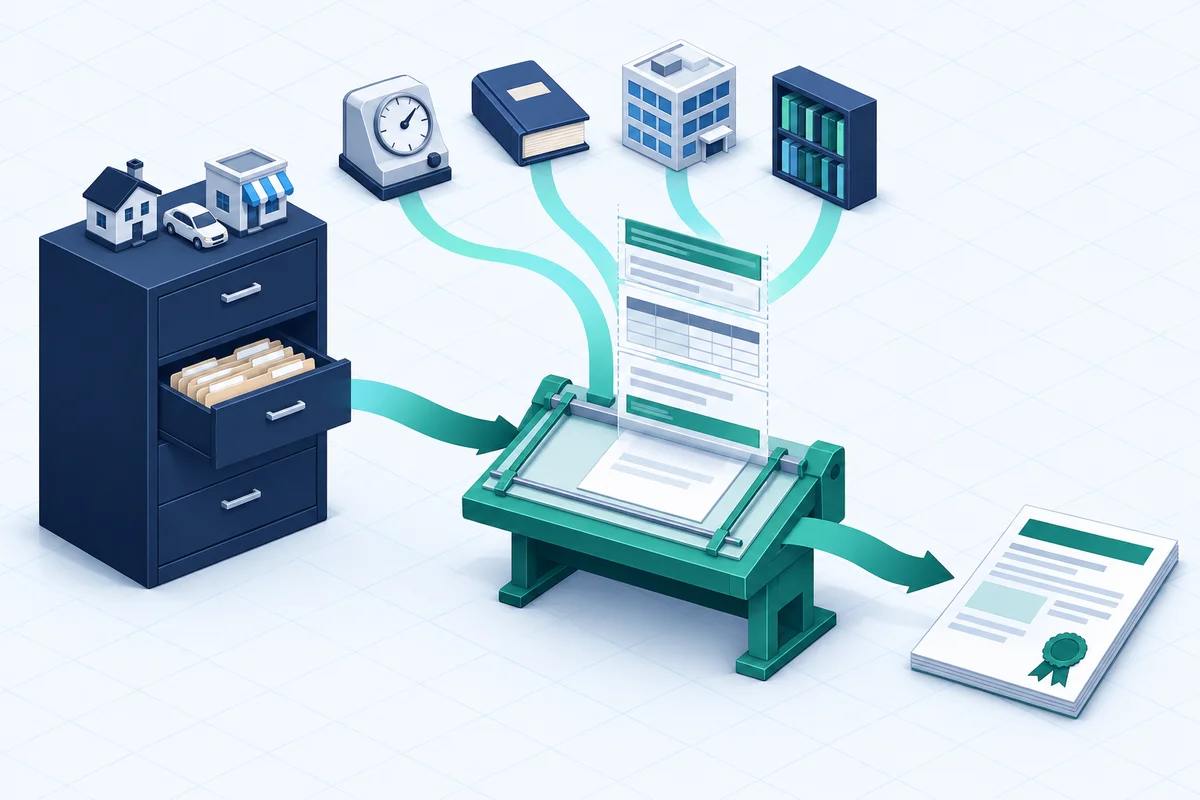
Experlogix Document Automation is deployed alongside existing systems rather than in place of them. In an agency architecture, HawkSoft remains the system of record for clients, policies and servicing; the document layer takes responsibility for assembly, workflow, delivery and evidence.
Practically, that means:
Business-owned templates. Operations and compliance staff maintain template content and the rules that drive it using low-code configuration, rather than filing a development ticket every time a disclosure, footer or carrier requirement changes. That reduces dependency on developers and external consultants and shortens the gap between "the wording changed" and "the wording is live".
Multi-source assembly. Experlogix Document Automation can draw on data from multiple systems — the AMS, CRM, ERP, databases and other line-of-business applications — so a single proposal or renewal packet reflects current data wherever it lives, with the conditional logic, lookups, filtering and calculations handled in configuration rather than in bespoke script.
Workflow and approvals. Smart Flows provides a drag-and-drop workflow builder for routing documents through review, approval, e-signature participation, delivery and storage. Executions run inside a defined security and permissions framework, and actions such as edits, approvals and timestamps are logged, which is what turns "we think the right letter went out" into a defensible record.
Compliance by construction. Embedded business rules apply jurisdiction-specific language and disclosures automatically, centralised content libraries keep approved wording in one place, and metadata tagging with automated archiving supports retrieval during audits.
Delivery and storage. Generated documents can be routed onward to e-signature services, email, portals or the agency's archive, with Experlogix retaining control over how documents are managed and delivered.
Integration as a One-Time Architectural Investment
The connection between an agency platform and a document layer is an API-led integration, and it is worth treating it as an architectural asset rather than a chore. The Experlogix Document Automation API is built for exactly this: a flexible interface with role-based API keys and an extensive library of calls that lets IT embed document generation into the workflows the business already uses.
Set up once, properly specified, that interface carries the agency for years. A sound integration design covers:
- The data contract: which fields, which structures, what happens when a value is missing, and how schema changes are versioned.
- Identity and access: service identities, role-based permissions, and which users may run which flows.
- Trigger design: which events generate synchronously for a user who is waiting, and which are queued, scheduled or batched for renewal and notice runs.
- Failure handling: duplicate triggers, retries, partial batches, delivery failures and how the agency reconciles what was produced against what should have been produced.
- Evidence and write-back: what gets logged, what is archived, and what status or document reference returns to the AMS so the client file stays complete.
IT sets this up and controls security, environments and releases. The business then owns the templates, wording and workflows day to day — which is the whole point.
AI, Governance and Human Oversight

Agency staff increasingly work through conversational assistants, and the obvious temptation is to let an assistant draft the client letter. That is the wrong division of labour for regulated correspondence.
A more defensible pattern separates conversation from execution. The Experlogix Document Automation Smart Flows MCP server — a Model Context Protocol server published for use in Microsoft Copilot Studio — allows Copilot agents to discover which Smart Flows are available, see what inputs each requires, collect missing details conversationally, trigger execution, track status and return the generated documents to the user. The agent contains no business logic; the document layer performs structured execution using approved templates and rules, inside the same security, permissions and logging framework that already applies. Administrators can monitor execution status and trace generated artefacts using familiar Experlogix tooling even when a flow is triggered conversationally.
The governance point is simple. AI can usefully assist with initiating workflows, gathering inputs and accelerating configuration and review. It should not be making coverage, eligibility, pricing or claims judgements, and every generated document should remain traceable to a template version, a data set, an approver and a delivery record. Human oversight is not a courtesy in a regulated business; it is the condition under which automation is allowed to scale.
Trade-Offs Worth Being Honest About
Adding a document layer adds a system to run. There is template migration effort, an integration to design and test, and a governance model to agree — who approves wording, who may publish a template, how form editions and effective dates are recorded so that a document issued two years ago can be reproduced as issued.
There is also a sequencing risk. Automating a broken process produces faster broken documents. Agencies that benefit most tend to rationalise their template estate first, decide what is genuinely required versus merely traditional, and then automate the result.
Finally, scale should be proven rather than assumed. Performance-test the renewal peak, the long commercial schedule and the mass notice run before they arrive in production, and confirm how partial failures are detected and resolved.
Summary
HawkSoft gives independent agencies a dependable system of record for clients, policies and servicing. Document work, by contrast, spans systems, jurisdictions, carriers, brands and volume profiles, which is why many agencies find value in combining their existing platform capabilities with a dedicated document automation layer rather than stretching any one system to cover everything.
If you are evaluating this for your agency, three steps are more useful than a feature comparison. First, inventory your document families and mark which ones draw data from more than one system or carry controlled wording. Second, decide ownership explicitly for each one — data, trigger, template, approver, delivery evidence, archive and write-back. Third, specify the integration properly: data contract, identity, trigger patterns, failure handling and evidence, so that the connection you build once continues to serve you as volumes and brands grow.
Done in that order, document automation stops being a project that competes with servicing work and becomes the quiet infrastructure that makes servicing work faster, more consistent and easier to defend.
Frequently Asked Questions
What role does HawkSoft play, and where does document production begin?
An agency management system (AMS) is the operational spine of an independent agency. HawkSoft holds the client file: household or commercial account details, policy records across carriers, servicing activity, notes and logs, attachments, and the servicing workflow that tells a CSR what needs doing today.
Where does insurance document complexity arise around HawkSoft?
Agency documents look simple until you examine the variation hiding inside them. Each of those document families has a different owner, a different approval expectation and a different retention rule. That is the practical argument for treating documents as their own governed layer rather than as a by-product of whichever system happened to trigger them.
When is native document output enough alongside HawkSoft?
Agency management systems, raters and carrier portals all produce documents, and nothing here suggests otherwise. The useful question is not "can the platform generate a document?" but "where should a particular document be governed?"
How can Experlogix Document Automation complement HawkSoft?
Experlogix Document Automation is deployed alongside existing systems rather than in place of them . In an agency architecture, HawkSoft remains the system of record for clients, policies and servicing; the document layer takes responsibility for assembly, workflow, delivery and evidence. Business-owned templates.
What role should governance play in AI-assisted insurance document workflows?
Agency staff increasingly work through conversational assistants, and the obvious temptation is to let an assistant draft the client letter. That is the wrong division of labour for regulated correspondence. A more defensible pattern separates conversation from execution.