
Guidewire InsuranceSuite (PolicyCenter, BillingCenter and ClaimCenter) sits at the operational centre of a great many property and casualty carriers. It holds the authoritative record of policies, billing activity and claims. Around that core, documents multiply: declarations pages, policy packets, endorsement notices, cancellation and non-renewal letters, claim acknowledgements, reservation-of-rights correspondence, premium audit reports and jurisdictional notices, each tied to a particular form edition, effective date and regulatory wording. When Guidewire document generation and document workflows depend on specialist technical skills for every wording change, operational agility becomes a scheduling problem rather than a business decision, and routine compliance updates queue behind the next release. Solve it well — with a governed, centrally managed document layer that business users can maintain — and the benefit compounds across every line of business and every jurisdiction.
TL;DR
- Guidewire document generation is only one part of a wider document estate: a single policy or claim transaction often triggers correspondence, packets, notices, attachments and archive events that span several systems.
- Document complexity in P&C comes from jurisdictional variation across states, provinces and regions, product-specific wording, effective-dated form editions, conditional clauses and data that must be calculated, filtered or unpacked before it can appear on a page.
- Many insurers combine their core platform’s native output with a dedicated document automation layer, keeping Guidewire as the system of record while centralising templates, assembly logic, approvals, delivery and evidence.
- Experlogix Document Automation is designed to be deployed alongside existing insurance systems, with Microsoft Word-based template design for business users, Smart Flows for workflow orchestration, Smart Forms for guided data capture, and a flexible API with role-based API keys for integration at scale.
- AI belongs in this picture as an assistant and an initiator — suggesting content, accelerating configuration and invoking governed workflows — never as an autonomous decision-maker in regulated insurance processes.
Happy shiny people. The industry loves to picture policyholders living their best lives, blissfully untroubled by the perils their cover quietly absorbs; a document layer that lets operations and compliance teams make accurate changes quickly, without heavy ongoing IT labour, extends a little of that same ease to the insurance professionals themselves.
Understanding the Document Footprint Around Guidewire
Guidewire’s InsuranceSuite applications are transactional systems. They govern policy state, billing state and claim state, and they include capabilities for producing template-based correspondence and policy documentation tied to those transactions. Guidewire Cloud Platform adds API-based access and event messaging, which is what makes a surrounding document layer architecturally straightforward rather than exotic.
The practical question for most carriers is not whether the core can produce documents. It is how much of the document estate genuinely belongs there.
Map the lifecycle and the footprint becomes clear:
- New business and submission: applications, supplemental questionnaires, risk summaries, quote comparisons, proposals and binders.
- Issuance: declarations, policy packets, master policies, evidence of coverage, certificates, schedules of locations or vehicles, and identification cards.
- Mid-term change: endorsement packets, revised declarations, premium adjustment explanations and producer notifications.
- Billing: invoices, instalment schedules, payment reminders, lapse warnings, cancellation notices and reinstatement confirmations.
- Renewal: renewal offers, renewal packets, premium increase explanations, non-renewal notices and conditional renewal notices where a jurisdiction prescribes them.
- Claims: acknowledgement letters, coverage position letters, independent adjuster instructions, settlement documentation, payment advices and closure letters.
- Audit and compliance: premium audit worksheets and results, regulatory notices, product disclosures, statutory and regulatory reporting packages, and reinsurance or bordereaux exchanges with third parties.
Some of these are tightly bound to a single transaction and live comfortably inside the core. Others draw on data from several systems at once, change frequently, require legal review, or must be assembled into a long composite packet. That second group is where document operations tends to get expensive.
Where Document Complexity Actually Emerges

Document complexity in P&C rarely comes from the layout. It comes from variability and from data.
Jurisdictional variation. Wording differs by state, province and region, and sometimes by county or municipality. Notice periods, required disclosures, font-size rules, language requirements and mandated form editions all vary. A single cancellation notice may have dozens of lawful variants.
Effective-dated content. A document reproduced two years after issuance must reflect the form edition and wording that applied at the time, not today’s version. That means template versioning and effective dating have to be first-class concepts, not a naming convention in a folder.
Conditional logic and derived values. Schedules must be filtered, totals calculated and coverage limits compared. Exclusions must be suppressed or included, and repeating sections expanded. A commercial property schedule with hundreds of locations is a very different assembly problem from a personal motor declarations page. Historically this logic has been expressed in code or script, which is precisely why wording changes end up on a development backlog.
Structured and nested source data. Data arriving from APIs is often nested, encoded or packaged in ways that cannot be printed as-is. It has to be unpacked, reshaped and validated before it becomes readable output.
Multiple systems of record. A renewal packet may need policy data from the core, client and producer context from an agency management system, authoritative form content from a licensed forms library, loss history from a data warehouse, and branding assets from a content repository. Each of those sources has its own access method, refresh cadence and ownership.
Volume with timing pressure. Renewal peaks, mass endorsements and catastrophe communications create concentrated bursts. In those windows, thousands of documents must be produced, delivered and evidenced quickly, while front-line staff still need interactive, on-demand generation.
One event, one governed document loop
Native Output or a Dedicated Document Layer? A Boundary Question, Not a Contest
Insurers rarely benefit from framing this as a replacement decision. Guidewire remains the system of record for policy, billing and claim state, and that should not change. The useful question is which responsibilities sit where.
A workable way to decide is to assign owners explicitly for each document type:
- Source of truth
- Which system holds the authoritative data for each field on the page.
- Trigger owner
- Which system detects the event (issuance, endorsement bound, claim status change, invoice generated, renewal offer created) and initiates generation.
- Template owner
- Which team maintains wording, branding, clause libraries and jurisdictional variants.
- Approval owner
- Who signs off wording changes, and who approves individual high-value or sensitive documents before release.
- Delivery owner
- Which system sends to post, email, portal, producer or third party.
- Archive owner
- Where the final rendered artefact and its delivery evidence are retained.
- Write-back owner
- Which system records the document reference, status and audit trail against the policy, claim or account.
Documents that are simple, stable and entirely core-resident often belong exactly where they are. Some documents are jurisdictionally variable, frequently amended, multi-source, composite or shared across more than one core platform. Those are the ones that typically justify a centralised document layer. Many carriers run both patterns deliberately, and that is a legitimate architecture rather than a compromise.
How Insurers Extend Guidewire with Experlogix Document Automation
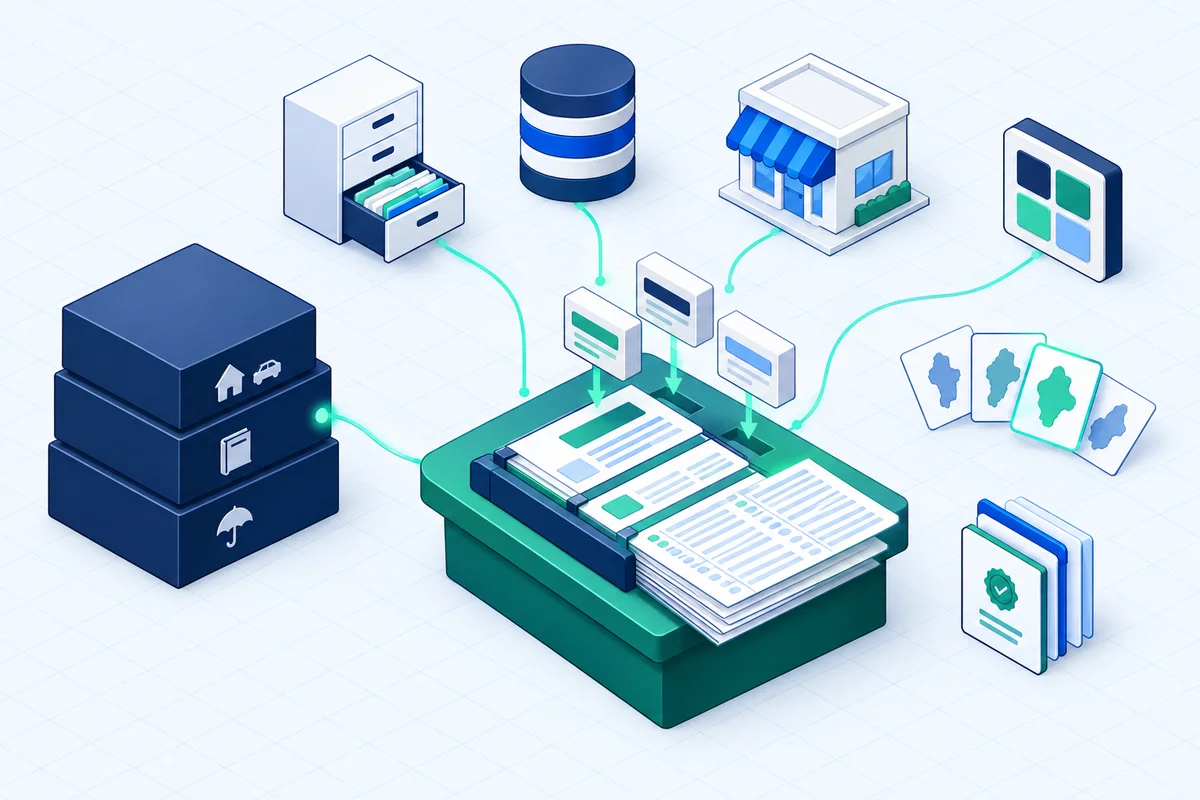
Experlogix Document Automation is an enterprise document automation platform that runs alongside existing core systems. It covers policy, claims and customer communications rather than replacing the transactional platforms that feed them. In a Guidewire context, the core typically continues to own the transaction. Experlogix handles assembly, routing, delivery and evidence for the document types that warrant central governance.
Several characteristics matter for insurance work specifically.
Business-user ownership of templates
Templates are designed in Microsoft Word with drag-and-drop data binding and conditional content, so wording changes do not require code. Jurisdiction-specific content and automatic language selection can be embedded within templates, reducing the need to maintain separate template versions manually. That is the practical mechanism behind reduced dependency on developers and consultants: a compliance analyst can amend a mandated notice and route it for approval without a release cycle. One medical professional liability carrier, Coverys, selected Experlogix Document Automation to make better use of its 300-plus existing templates and completed its migration on time and on budget.
Workflow orchestration with Smart Flows
Smart Flows lets business users create, generate, manage, store, deliver and e-sign documents without code. Its flow steps cover data collection, generation, approval, storage and delivery. A document can be previewed mid-flow: execution pauses after the generation step so a user can check the output before storage or delivery steps run, and can cancel the remaining steps if the document fails inspection. Smart Flows also integrates with Microsoft Power Automate in both directions, so approval processes, SharePoint libraries and other enterprise connectors can take part in the document workflow.
Guided data capture with Smart Forms
Smart Forms combined with digital policy documents give brokers forms that adapt to the customer's situation through pre-configured business rules. This improves data quality at the point of capture and reduces downstream rework, which is useful for applications, supplemental questionnaires and claim intake.
Integration through a flexible API
The Experlogix Document Automation API provides an extensive library of API calls with role-based API keys, so document generation and automation capabilities can be embedded in other applications. The platform can also combine multiple data sources into a single document: CRM, core system, data warehouse and external services reached through HTTP connectors. Together, these support the central architectural goal of one governed template estate serving several platforms, brands, products and jurisdictions.
API-led integration
API-led integration is a one-time design exercise with durable architectural benefits:
- Events in the core become workflow triggers.
- A clear data contract defines the fields, types, nested structures and defaults the document needs.
- Identity and role-based access control govern who and what may invoke a flow.
- The same interface handles both a single interactive document and a renewal batch.
Design for resilience
Treat the contract as a versioned asset, and define behaviour for missing values and schema changes. Make triggers idempotent so duplicate events do not produce duplicate notices. Plan explicitly for retries, partial batch failures, reconciliation and monitoring. Performance-test the peaks before they arrive rather than during them: renewal cycles, mass endorsements, catastrophe communications and long commercial schedules.
Delivery, signature, archive and write-back
Generated documents can be routed to e-signature services, stored in SharePoint or other repositories, or printed where a hard copy is requested. They can also be written back to the originating record, so the policy, claim or account carries the reference and status. That closing loop turns document generation into defensible evidence: the right document, from the right template version, approved, delivered and retained.
AI, Governance and Human Oversight

AI is most valuable here in two distinct roles, both of which stay inside the governance perimeter.
The first is configuration assistance: accelerating template creation, suggesting content, helping map data and shortening the path from requirement to working workflow. This is a productivity gain for the people building and maintaining the document estate.
The second is agent-initiated workflow execution. The Experlogix Smart Flows MCP server is a Model Context Protocol server published for use in Microsoft Copilot Studio. Through it, Copilot agents can:
- Discover which Smart Flows are available.
- See what inputs each flow requires and in what structure.
- Trigger execution and track execution state.
- Retrieve the resulting documents and metadata.
The architectural point is that automation logic stays in the governed flow rather than inside the agent. An underwriter or claims handler can ask for a document in natural language, and the agent gathers and validates the required inputs. The governed flow then sources data, applies rules, selects the correct template version, routes for approval, delivers and archives.
That boundary matters in a regulated industry. AI assists, prepares and initiates; it does not decide coverage, pricing, eligibility or claim outcomes. Supervisory attention to AI in insurance has sharpened accordingly. Regulators across states, provinces and regions are signalling clear expectations around governance, human oversight, data privacy, security and the risk of inaccurate AI-generated output. Any AI-involved document action should therefore record its source data, template version, approvals and provenance exactly as a human-initiated one would.
Business Ownership Without Weakening IT Control

This architecture does not force a trade-off between agility and control. Responsibilities simply separate along their natural lines.
Operations and compliance own wording, clause libraries, jurisdictional variants and approval rules. Product owns which form editions and effective dates apply to which products and territories. IT and security own integrations, service identities, environments, release governance, monitoring and retention. Carriers have long said they want a platform business users can own, while IT keeps the tools to make more complex changes and rule configurations. This model formalises that division of labour.
The practical test is simple: when a regulator mandates a wording change across a handful of jurisdictions, how many teams and how many weeks does it take? If the answer is a compliance analyst, an approver and a few days, the document layer is doing its job.
Summary
Guidewire holds the authoritative policy, billing and claims record. The surrounding document estate (packets, notices, correspondence, audit and regulatory output) is where variability, jurisdictional nuance and multi-system data requirements concentrate. Deciding deliberately which documents stay native and which belong in a centralised, governed document layer is the most valuable architectural conversation most carriers can have on this topic.
For the documents that justify centralisation, the criteria worth applying are concrete:
- Business-user template ownership under compliance approval.
- Effective-dated version control.
- The ability to combine data from several systems of record.
- Workflow orchestration through delivery and archive.
- Reliable write-back of document references.
- Failure handling that survives duplicate events, missing data and partial batches.
Experlogix Document Automation addresses that layer while Guidewire continues to do what it does. Together, they let insurers keep their core investment intact while making document change a business activity rather than a development project.
A reasonable next step is to inventory your current document types. Tag each one with its true data sources, change frequency, jurisdictional variability and approval path, and let that inventory, not habit, decide where each document should be produced.
Frequently Asked Questions
What role does Guidewire play, and where does document production begin?
Guidewire's InsuranceSuite applications are transactional systems. They govern policy state, billing state and claim state, and they include capabilities for producing template-based correspondence and policy documentation tied to those transactions. Guidewire Cloud Platform adds API-based access and event messaging, which is what makes a surrounding document layer architecturally straightforward rather than exotic.
Where does insurance document complexity arise around Guidewire?
Document complexity in P&C rarely comes from the layout. It comes from variability and from data. Jurisdictional variation. Wording differs by state, province and region, and sometimes by county or municipality. Notice periods, required disclosures , font-size rules, language requirements and mandated form editions all vary.
When is native document output enough alongside Guidewire?
Insurers rarely benefit from framing this as a replacement decision. Guidewire remains the system of record for policy, billing and claim state, and that should not change. The useful question is which responsibilities sit where.
How can Experlogix Document Automation complement Guidewire?
Experlogix Document Automation is an enterprise document automation platform that runs alongside existing core systems. It covers policy, claims and customer communications rather than replacing the transactional platforms that feed them. In a Guidewire context, the core typically continues to own the transaction.
Who should own document templates, approvals and governed changes?
This architecture does not force a trade-off between agility and control. Responsibilities simply separate along their natural lines. Operations and compliance own wording, clause libraries, jurisdictional variants and approval rules. Product owns which form editions and effective dates apply to which products and territories.