Complexity rarely announces itself. It builds one exception, approval, pricing rule, and workaround at a time, until quoting starts demanding far more effort than it should.
One new product option becomes five. A pricing exception becomes standard practice. Services get added to product deals. New markets introduce different compliance requirements. Discounts require another approval. Someone creates a spreadsheet to make the process easier.
Eventually, the quoting process that worked perfectly well a few years ago is carrying far more weight than it was ever designed to handle.
The difficult part is knowing when you have crossed that line. Your team may still be producing quotes. Deals may still be closing. Nothing is technically broken. But underneath the surface, exceptions, workarounds, spreadsheets, approvals, pricing dependencies, and manual handoffs may be multiplying.
Where is quoting complexity hiding?
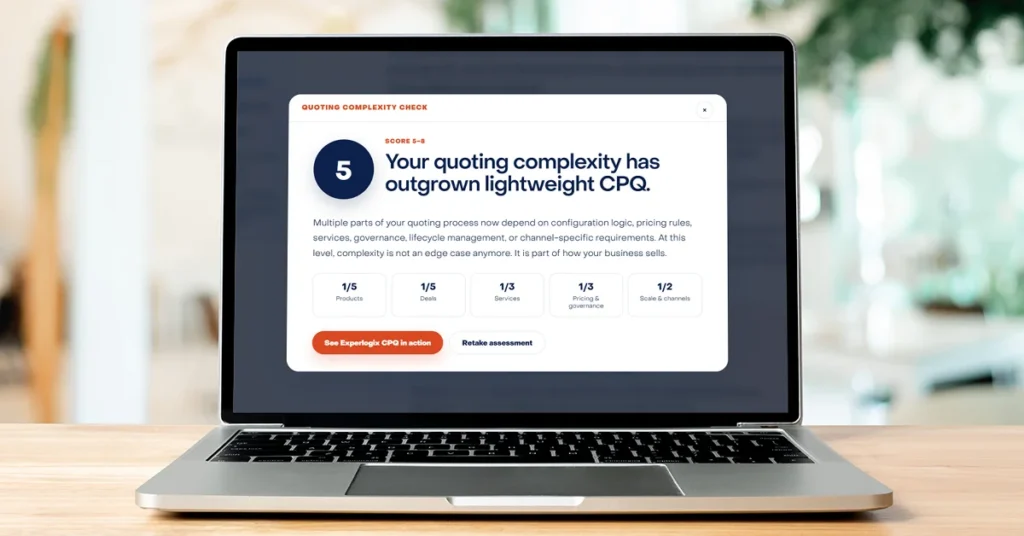
Answer five quick questions to see how many complexity signals are showing up across your products, deals, services, pricing, and sales channels.
Complexity usually starts with the product
Product complexity creates a domino effect. One configuration choice determines which components, accessories, services, or features can come next. Compliance requirements may change according to geography. Custom engineering gets mixed with standard products. And a quote eventually has to translate into something operations can actually build.
This is also where some organizations discover that the unofficial heart of their quoting system is a spreadsheet filled with formulas, macros, institutional knowledge, and crossed fingers. When product logic becomes too complicated for a salesperson to reliably remember, the quoting system needs to carry that logic instead.
Then the deal itself gets complicated
Modern deals do not always fit neatly into quantity × price. A single agreement may combine one-time charges, subscriptions, usage pricing, services, installation, implementation, maintenance, and other commercial models.
Prices may depend on other configured items. Finance may need annual contract value, total contract value, monthly recurring revenue, estimated usage, and other calculations from the same deal. Then the customer renews, adds something halfway through the term, or needs a new subscription to end on exactly the same date as an existing agreement.
What started as quoting gradually becomes lifecycle management.
Services introduce another layer
Services often create complexity differently than products do. Hours get estimated manually. Different roles have different rates. Rates change by location or skill level. Fixed-price work sits beside time-and-materials work.
Scope changes create their own problem. When calculating the price of additional work takes longer than simply doing the work, teams start giving that work away. That is not just an operational inconvenience. It becomes a margin problem.
Pricing and governance eventually feel the strain
As quotes become more sophisticated, organizations need to answer questions that used to be simple. What is the actual margin on this bundled deal? Who can approve this discount? Which approval threshold applies? Is this salesperson using the current price? What happens when material or input costs change faster than the price list?
If those answers require email threads, spreadsheets, finance reconstruction, or someone who simply “knows how it works,” quoting complexity has moved beyond the sales team. It has become a governance issue.
Scale magnifies every weakness
A process that works for one sales team may fall apart when distributors, partners, regions, business units, or additional sales channels enter the picture. Different groups may need different products, catalogs, prices, permissions, currencies, or approval rules.
One particularly useful warning sign appears when the official quoting process becomes cumbersome enough that salespeople begin creating quotes somewhere else. Shadow spreadsheets and unofficial quoting tools are not usually the root problem. They are symptoms.
You have seen the warning signs. Now see where you land.
Five quick questions turn the signals above into a personalized complexity score, with a breakdown of where the most friction is showing up.
Why the score matters: quoting complexity is often manageable long before it becomes visible as a technology problem. The assessment is designed to surface how much configuration, pricing, services, governance, and channel complexity the current process is already carrying.
Quoting Complexity Check
Find out where quoting complexity is starting to build.
You will go through five quick questions covering products, deals, services, pricing and approvals, and sales channels. On each screen, simply select every statement that sounds familiar. We will calculate your score and category breakdown for you.
Where is product complexity showing up?
Select every statement that sounds familiar.
Where are your deals getting harder to manage?
Select every statement that sounds familiar.
Where are services creating quoting friction?
Select every statement that sounds familiar.
Where are pricing and approvals slowing things down?
Select every statement that sounds familiar.
Where is scale putting pressure on the process?
Select every statement that sounds familiar.
Your result is ready.
Tell us who you are to reveal your complexity score and category breakdown.