
Vertafore sits at the operational centre of a great many agencies, brokerages and MGAs, holding the client, policy, producer and servicing record that distribution teams work in every day. The documents that surround that record, however, rarely behave as neatly: applications, proposals, certificates, summaries of insurance, renewal packets, cancellation and lapse notices, carrier submissions and claim acknowledgements each draw on different data, different wording and different approvals. When those documents depend on manual assembly, copy-and-paste between systems, or a queue of change requests sitting with IT and outside consultants, the whole distribution operation inherits the delay. Solve it, and you get something more valuable than speed: accurate documents produced by the people accountable for them.
TL;DR
- Vertafore products hold authoritative client, policy, producer and servicing context for distribution teams; a dedicated document layer handles the assembly, routing, approval, delivery and evidence that surrounds those records.
- Agency and broker document complexity comes from variation: jurisdiction (state, province or region), carrier, product, programme, brand and effective date — all of which change more often than core system configuration does.
- Experlogix Document Automation is deployed alongside existing systems rather than in place of them, using a Microsoft Word-based template builder, Smart Forms for data capture, Smart Flows for workflow, and an API that connects to an unlimited number of data sources.
- Governance is the deciding factor: template version control, embedded business rules, audit trails, and plug-and-play connections to eSignature platforms including DocuSign, Adobe Acrobat Sign, OneSpan Sign, Sertifi and ConsignO Cloud.
- AI belongs inside the governed workflow, not outside it: every document generated through Experlogix is traceable and every agent action is logged, with humans retaining control over where the boundaries sit.
Happy shiny people. The industry loves to picture policyholders living their best lives, blissfully unbothered by the catastrophes their cover quietly absorbs — and a centralised document layer that lets business teams manage document automation accurately and quickly, without heavy ongoing IT labour, lets insurance professionals live a rather better life too.
Understanding Where Vertafore Fits in the Distribution Stack
Vertafore is best understood as an ecosystem rather than a single application. Agencies and brokerages typically run an agency management system (AMS) as the operational hub — AMS360 and QQCatalyst are among the widely used examples — supported by personal lines comparative rating, analytics, and insurance knowledge and research tools such as ReferenceConnect, which aggregates authoritative publisher content. Carrier connectivity, download and producer servicing then wrap around that core.
The important architectural point for document work is this: the AMS is the system of record for the client, policy, producer and activity context. It knows who the insured is, which carrier wrote the risk, what the effective dates are, and which servicing team owns the account. It is not, however, the only system involved when a document is produced. A single renewal proposal might need AMS policy data, carrier quote results, a rating or comparison output, approved disclosure wording from a content authority, and the agency’s own brand assets. That multi-system reality is where document automation earns its keep.
Many platforms in this space already produce output of some kind — forms, ACORD applications, letters, reports. The question for most agencies is not whether their platform can produce a document. It is whether the full set of documents they are accountable for can be produced, approved, delivered, archived and evidenced consistently, at volume, with business users in control of the wording.
Where Document Complexity Actually Emerges

Document complexity in distribution is rarely about layout. It is about variation and data.
Jurisdictional and product variation
Wording changes by state, province and region. Required notices differ by line of business and programme. Carrier-specific endorsements and manuscript wording vary by appointment. A commercial account with locations in several jurisdictions can require a single packet assembled from several wording sets. Maintaining these as separate static documents multiplies the maintenance burden with every new variation.
Experlogix addresses this with a Template Builder that uses familiar Microsoft Word functionality to create templates with dynamic data fields pulled directly from connected systems, embedded jurisdiction-specific content, dynamic tables and graphics, and automatic language selection — which reduces the need to maintain separate template versions manually.
Data that is never simply output as-is
Source data almost never drops cleanly into a document. Schedules need unpacking and sorting. Premiums need totalling and apportioning. Coverage limits need formatting and comparison. Producer and commission details need lookups. Conditional sections need to appear only when a trigger condition is met. Traditionally, each of these rules becomes a development or consulting request. Logic-driven templates that support conditional formatting, dynamic content, regulatory language and branding elements move that work to the business team, while version control ensures teams always use the most up-to-date, approved formats.
Volume and timing
Renewal cycles, mass notice runs, programme-wide endorsements and catastrophe communications are not steady-state workloads; they arrive in peaks. Enterprise-grade document automation is built to handle thousands or millions of documents with intricate formatting, dynamic content and conditional logic, assembling anything from a one-page invoice to a long packet in seconds using business rules. Interactive, on-demand generation for a service team member sits alongside that batch capacity, which is why peak-volume testing deserves a place in any implementation plan.
Incomplete data at the point of generation
Not every field a document needs is already in the AMS. Smart Forms address this by including customisable forms as part of an automated workflow — a flow might send an email containing a form link, and form completion then triggers document generation. For broker-facing application work, combining Smart Forms with digital policy documents allows pre-configured business rules to adapt each form to the customer’s specific situation, improving data accuracy while reducing completion time.
The Document Lifecycle Around a Vertafore Ecosystem
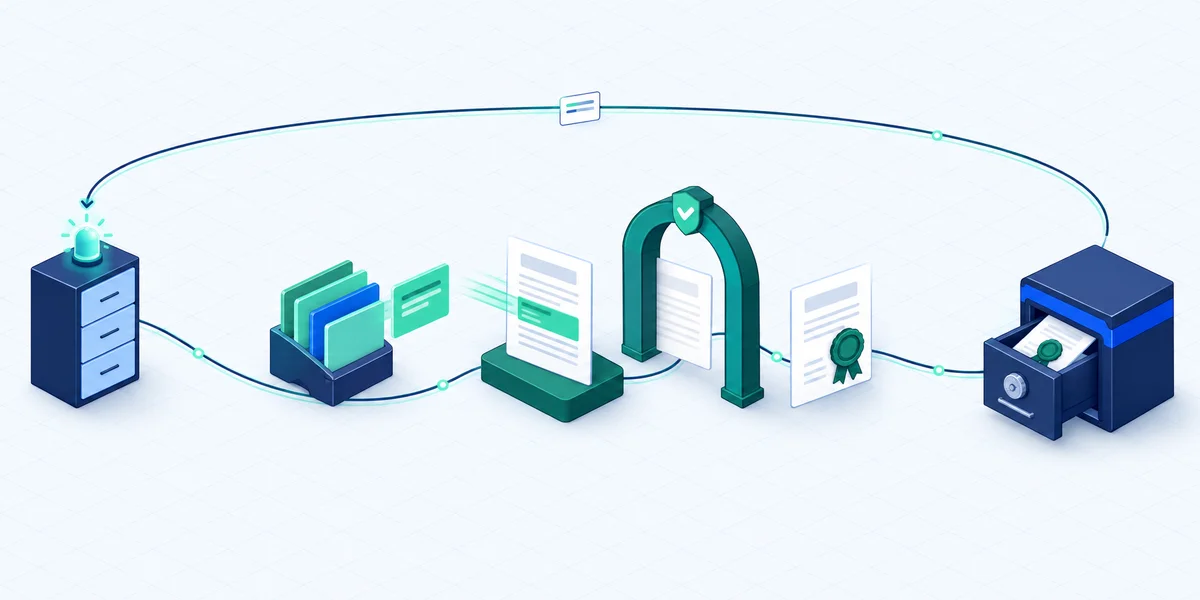
A useful way to scope a Vertafore document automation initiative is to walk the distribution lifecycle and mark where documents are created, approved, delivered and retained.
- Before bind: submissions, applications, supplemental questionnaires, proposals and coverage comparisons, carrier cover letters.
- At bind: binders, confirmations of cover, invoices, finance agreements, ID cards and certificates.
- After bind: policy summaries, evidence of coverage, welcome packets, certificate holder notifications.
- Mid-term: endorsement confirmations, change acknowledgements, premium adjustment notices, loss run requests.
- Renewal: renewal proposals, remarketing comparisons, premium increase notices, non-renewal and cancellation notices.
- Claims and servicing: first-notice acknowledgements, status correspondence, adjuster coordination letters, settlement documentation.
- Compliance and commercial: producer agreements, licensing and appointment documentation, audit reports, commission statements, programme and bordereaux reporting.
For each one, six ownership questions are worth answering explicitly: which system holds the source data, what triggers generation, who owns the template, who approves the wording, where the final artefact is archived, and what gets written back to the client, policy or activity record. Answering those six questions is usually more valuable than any feature comparison.
Integration Architecture: API-Led, Configured Once, Governed Continuously
The architectural pattern most agencies and brokers land on is straightforward. A business event — a policy change, a renewal milestone, a quote acceptance, a claim status update — triggers a document workflow. The workflow retrieves governed data from the relevant systems, applies rules, selects the correct template and wording for the jurisdiction and effective date, assembles the document, routes it for approval, obtains signature where required, delivers it, archives it, and writes status and references back to the originating record.
Experlogix supports this with a flexible API offering role-based API keys, an extensive library of API calls and programmable functionality, allowing document generation and automation capabilities to be implemented within virtually any application. Alongside that, there is out-of-the-box integration with major business platforms including Microsoft Dynamics 365 and Salesforce, and the ability to connect to an unlimited number of data sources — CRM, ERP, ECM, databases and in-house applications.
This is a one-time integration design exercise that pays off continuously. Once the data contract is defined — fields, nested structures, defaults for missing values, and behaviour when a schema changes — the same connection supports every document type that draws on that data. Identity, permissions and environment control remain with IT; wording and template content remain with operations and compliance. The architecture scales with volume rather than requiring rework for each new document.
Three integration points deserve early attention.
- First, Signature électronique: Experlogix offers plug-and-play connections to DocuSign, Adobe Acrobat Sign, OneSpan Sign, Sertifi and ConsignO Cloud, keeping generation, signature and storage within one end-to-end process.
- Second, storage and archive: documents belong in a controlled repository with retrieval and version control, whether that is Microsoft SharePoint, an enterprise content management system or a connected storage platform.
- Third, workflow orchestration: Experlogix Smart Flows integrates with Microsoft Power Automate in both directions, so document generation can be triggered from automated, button, scheduled or business process flows, and existing Microsoft approval processes can be used to approve Smart Flows-generated documents.
Security sits underneath all of it. Experlogix maintains SOC 2 compliance and follows industry standards including NIST and OWASP guidance — a relevant consideration given the personal and commercial data that flows through distribution documents.
Business Ownership Without Losing Control

The strongest argument for a dedicated document layer in an agency or brokerage is rarely technical. It is about who can make a change on a Tuesday afternoon.
When a carrier revises wording, a regulator updates a required notice, or a programme adds a new disclosure, the people who understand the change are in operations, compliance or programme management — not in a development queue. A low-code template builder based on familiar Word functionality lets those people build and amend templates without coding knowledge, while a visual drag-and-drop workflow builder with conditional logic lets them adjust routing without IT dependence. Template version control, approval routing and audit-ready records keep that freedom inside proper boundaries, and collaboration features such as versioning, track changes and commenting support multi-stakeholder review before anything reaches a client.
The practical division of labour looks like this: IT sets up the integrations, identity, environments and monitoring once; operations and compliance own wording, approvals and template lifecycle thereafter. That split is what reduces dependency on specialised consulting resources and shortens the time between a wording decision and a wording change appearing in production documents.
AI, Governance and Agent-Initiated Document Work

AI is now a live consideration in insurance document work, and it should be a governed one. Every AI-driven action that touches a policy, a claim or a customer communication carries compliance implications, and explainability, auditability and data governance are the conditions under which AI can be deployed at all.
The useful pattern is AI operating inside pre-defined workflows rather than around them. Experlogix Document Automation includes the Smart Flows MCP Server — MCP (Model Context Protocol) being the emerging standard that lets AI agents connect to existing systems such as a policy management platform, CRM or compliance engine in a structured, auditable way. It allows AI agents to discover available Smart Flows, gather and validate the required inputs, execute the flow, track its status and return the generated documents, while Smart Flows retains control over how those documents are managed and delivered. That gives agents the context to act and gives the organisation the governance layer to define exactly how they act. Practically, it means a service team member or an internal AI assistant can request a renewal packet or a status letter, and the request is executed through the same governed pipeline: approved template, correct jurisdictional wording, sourced data, required approvals, logged actions.
Two boundaries matter. AI assists with document creation, workflow configuration and review; it does not make coverage, pricing, eligibility or claims decisions. And every generated document remains traceable, with every agent action logged — the system operates as a transparent, auditable extension of the existing workflow rather than a black box. The gain here is productivity: less time assembling and checking, more time on the judgement-heavy work that people are actually paid for.
Architectural Trade-Offs Worth Being Honest About
Centralising document work is one reasonable approach, not the only one. A few trade-offs deserve open discussion before scoping.
Documents that are tightly bound to a platform's own transactional processing, produced in low volume, and rarely changed are often fine where they are. The strongest candidates for a dedicated document layer are the opposite: high variation, frequent wording changes, multi-system data dependencies, approval requirements, or a need for identical output across several brands, programmes or systems.
Centralisation also creates a single governed template estate, which is an advantage for consistency and an obligation for discipline. Someone has to own the template catalogue, the effective-date rules and the retirement of superseded wording. Likewise, failure paths need design attention from the outset: missing data, duplicate triggers, retries, partial batch failures, delivery failures, write-back errors and reconciliation. Workflows that track every step support full visibility and audit trails, but the exception handling still has to be specified deliberately.
Finally, the sequencing matters. Applying automation or AI to a process that is not yet sound tends to add complexity rather than remove it. Document the current process first, then automate it.
Summary
For agencies, brokerages and MGAs running on Vertafore products, the opportunity is not to replace the systems holding the client, policy and producer record. It is to give the documents that surround those records a proper home — one where templates, wording, rules, approvals, delivery and evidence are managed in one governed place and maintained by the business teams accountable for them.
Three findings carry most of the weight. First, document complexity in distribution comes from variation across jurisdictions, carriers, products and effective dates, and that variation changes far more often than core configuration does. Second, API-led integration configured once provides a durable foundation for both interactive and high-volume generation, with identity, security and environment control staying with IT. Third, governance is the enabler rather than the constraint: version control, embedded business rules, approval routing and complete audit trails are what make business-user ownership safe, and what make AI assistance acceptable in a regulated setting.
A sensible next step is a short scoping exercise rather than a platform decision. Pick the three or four document types that generate the most rework or the longest waits — renewal proposals, certificates, cancellation notices and claim correspondence are common candidates — and for each one, write down the source system, the trigger, the template owner, the approver, the archive destination and the write-back. The pattern that emerges from that exercise will tell you, with far more precision than any vendor comparison, which documents belong where and how much operational agility is currently sitting on the wrong side of a development queue.
Frequently Asked Questions
What role does Vertafore play, and where does document production begin?
Vertafore is best understood as an ecosystem rather than a single application. Agencies and brokerages typically run an agency management system (AMS) as the operational hub — AMS360 and QQCatalyst are among the widely used examples — supported by personal lines comparative rating, analytics, and insurance knowledge and research tools such as ReferenceConnect, which aggregates authoritative publisher content.
Where does insurance document complexity arise around Vertafore?
Document complexity in distribution is rarely about layout. It is about variation and data. Wording changes by state, province and region. Required notices differ by line of business and programme. Carrier-specific endorsements and manuscript wording vary by appointment. A commercial account with locations in several jurisdictions can require a single packet assembled from several wording sets.
Which document workflows extend around Vertafore?
A useful way to scope a Vertafore document automation initiative is to walk the distribution lifecycle and mark where documents are created, approved, delivered and retained. Before bind: submissions, applications, supplemental questionnaires, proposals and coverage comparisons, carrier cover letters. At bind: binders, confirmations of cover, invoices, finance agreements, ID cards and certificates.
How should a governed document layer connect with Vertafore?
The architectural pattern most agencies and brokers land on is straightforward. A business event — a policy change, a renewal milestone, a quote acceptance, a claim status update — triggers a document workflow. The workflow retrieves governed data from the relevant systems, applies rules, selects the correct template and wording for the jurisdiction and effective date, assembles the document, routes it for approval, obtains signature where required, delivers it, archives it, and writes status and references back to the originating record.
Who should own document templates, approvals and governed changes?
The strongest argument for a dedicated document layer in an agency or brokerage is rarely technical. It is about who can make a change on a Tuesday afternoon. When a carrier revises wording, a regulator updates a required notice, or a programme adds a new disclosure, the people who understand the change are in operations, compliance or programme management — not in a development queue.