
BindRabbit belongs to the underwriting and rating layer of the insurance technology stack, where submissions are shaped, markets are approached, quotes are compared, and risks move towards bind. The paperwork that surrounds that workflow — applications, supplementals, quote comparisons, proposals, binders, certificates, and the signed acknowledgements that follow — rarely lives in one place, and it is usually assembled by people under deadline pressure rather than by a governed system. When that assembly stays manual or stays dependent on developers, every new product, broker brand, or regional wording change becomes a queue item instead of a configuration change.
TL;DR
- BindRabbit sits in the quote-to-bind and rating part of the lifecycle; the documents it touches — applications, supplementals, quote comparisons, proposals, binders, confirmations — carry regulated wording, effective dates, and producer branding that must stay controlled.
- Most distribution teams generate these documents across several systems at once: the rating or quote-to-bind platform, an agency management system, a carrier policy administration system, and a CRM. Pulling that data together by hand is where errors and delays appear.
- A dedicated document layer such as Experlogix Document Automation can sit alongside BindRabbit as a governed place for templates, assembly logic, approvals, delivery and archiving — complementing the platform’s operational role rather than replacing it.
- API-led integration gives this architecture its strength: one validated data contract, one template estate, and consistent output across multiple products, jurisdictions and brands.
- AI can help draft templates, gather inputs and initiate governed workflows, but underwriting, pricing, eligibility and coverage decisions must remain with authorised people and systems, with full traceability.
Happy shiny people. The insurance industry loves the image of policyholders living their best lives, blissfully unbothered by the catastrophes their cover quietly stands behind. A centralised document layer that lets business users manage document automation accurately and quickly, without heavy ongoing IT labour, lets the insurance professionals behind the scenes live their best lives too.
Understanding Where BindRabbit Fits in the Insurance Lifecycle
BindRabbit operates in the pre-bind portion of the insurance lifecycle: capturing and structuring application data, supporting rating and quoting activity, and helping distribution teams move a submission towards a bound risk. That makes it an operational system for the quoting conversation rather than a system of record for the issued policy. The policy administration system (PAS) still owns the issued contract, the agency management system (AMS) still owns the client, producer and accounting context, and the carrier still owns rating rules and underwriting authority.
This boundary matters for documents. Anything generated before bind — a proposal, a comparison summary, a binder confirmation — must be reproducible later, because it forms part of the evidence trail for what was offered, on what terms, with which forms attached, and when. Anything generated after bind usually belongs to the carrier’s issuance process. A sensible document architecture around BindRabbit makes that handover explicit rather than leaving it to habit.
The Documents That Surround a Quote-to-Bind Platform

It is worth listing the document touchpoints explicitly, because the volume is usually higher than teams estimate.
Each item carries its own data dependencies, approval expectations, delivery channel and retention rule. A proposal may need a producer’s logo and a compliance-approved disclaimer. A certificate may need an exact holder description. A required notice may need jurisdiction-specific wording that changes when regulators publish an update.
- Before the quote
- Applications and ACORD-style submission forms
- Supplemental questionnaires for specific classes of business
- Loss run requests and submission cover notes to markets
- At quote
- Individual carrier quote summaries
- Multi-market comparison documents showing limits, deductibles, exclusions and premium
- Client-facing proposals with producer branding, coverage narratives and recommendations
- At bind
- Binder confirmations and evidence of cover
- Certificates of insurance and evidence of property insurance
- Signed applications, disclosure acknowledgements and required notices
- Premium finance agreements and payment authorisations
- After bind and into servicing
- Policy packets, declarations and endorsement documentation produced by the carrier
- Renewal proposals and remarketing comparisons
- Cancellation, lapse and premium-change notices
- Audit requests and producer compensation disclosures
Where Document Complexity Actually Emerges
Jurisdiction, product and edition variation
Insurance wording varies by state, province and region, by product, and by distribution agreement. Multiply those dimensions together and a modest book of business can require hundreds of wording permutations. The complexity is not the number of templates; it is keeping the right wording tied to the right effective date, so that a document reproduced during a dispute or an audit matches what was actually issued.
Data that will not drop straight into a document
Quote and rating data is structured for calculation, not for reading. Coverage arrays, schedules of locations or vehicles, tiered limits, surcharge breakdowns and tax components usually need unpacking, filtering, totalling and re-sorting before they make sense on a page. Conditional logic — show this clause only for this class, suppress this section when a deductible exceeds a threshold — is the part that traditionally gets handed to developers or consultants and then becomes a backlog item every time a product changes.
Multiple systems of record in a single document
A single renewal proposal might combine quote results from the rating platform, client and policy history from the AMS, prior-term details from the carrier PAS, and relationship context from a CRM such as Microsoft Dynamics 365 or Salesforce. No one system holds the whole picture, which is why document assembly so often becomes manual copy-and-paste.
Peaks
Renewal seasons, mass remarketing exercises and catastrophe communications all produce bursts of document volume. Long commercial schedules compound the problem. Volume behaviour should be tested deliberately rather than discovered during a busy quarter.
Integration Architecture: Triggers, Data Contracts and Evidence
Treat the architecture as a chain: a platform event becomes a validated trigger, which prompts governed data retrieval, rule-driven template selection, assembly, approval or signature, delivery, archiving, and a status write-back to the originating system.
API-led integration is what makes this dependable. Experlogix Document Automation provides an API that allows document generation and workflow capabilities to be called from external applications, and it can connect to an unlimited number of data sources, including in-house systems. In practice, that means a one-time integration design — endpoints, authentication, field mapping, error handling — followed by ongoing configuration that business teams can own. The same architecture is designed to absorb growing document volumes, from interactive, one-at-a-time generation through to large scheduled runs.
- Platform event
- Validated trigger
- Governed data retrieval
- Rule-driven template selection
- Assembly
- Approval or signature
- Delivery
- Archiving
- Status write-back
Several design decisions deserve early attention:
- Trigger mode. Should a proposal generate synchronously while a producer waits, or should a renewal batch be queued and scheduled overnight?
- Data contract. Which fields are mandatory, what happens when a value is missing, how are nested structures represented, and how will schema changes be versioned?
- Identity. Which service accounts and roles may request which documents, and how are producer-level permissions reflected in output?
- Failure paths. Duplicate events, retries, partial batches, delivery bounces and failed write-backs all need defined handling. Idempotency keys and reconciliation reporting are unglamorous but they are what keep operations trustworthy.
- Evidence. Which template version, which data snapshot, which approver, which signature, which channel, which retention rule. Experlogix workflows route documents through approvals, delivery and archiving while tracking each step, which is what produces a usable audit trail.
Downstream systems fit into the same chain: e-signature platforms such as DocuSign or Adobe Acrobat Sign for signed applications and acknowledgements; Microsoft SharePoint for storage and archiving, alongside enterprise content management systems such as OpenText or Hyland where they form part of the organisation's estate; Microsoft Power Automate for broader process orchestration; and the AMS or PAS for write-back of document references and status.
Business Ownership Without Weakening Compliance Control
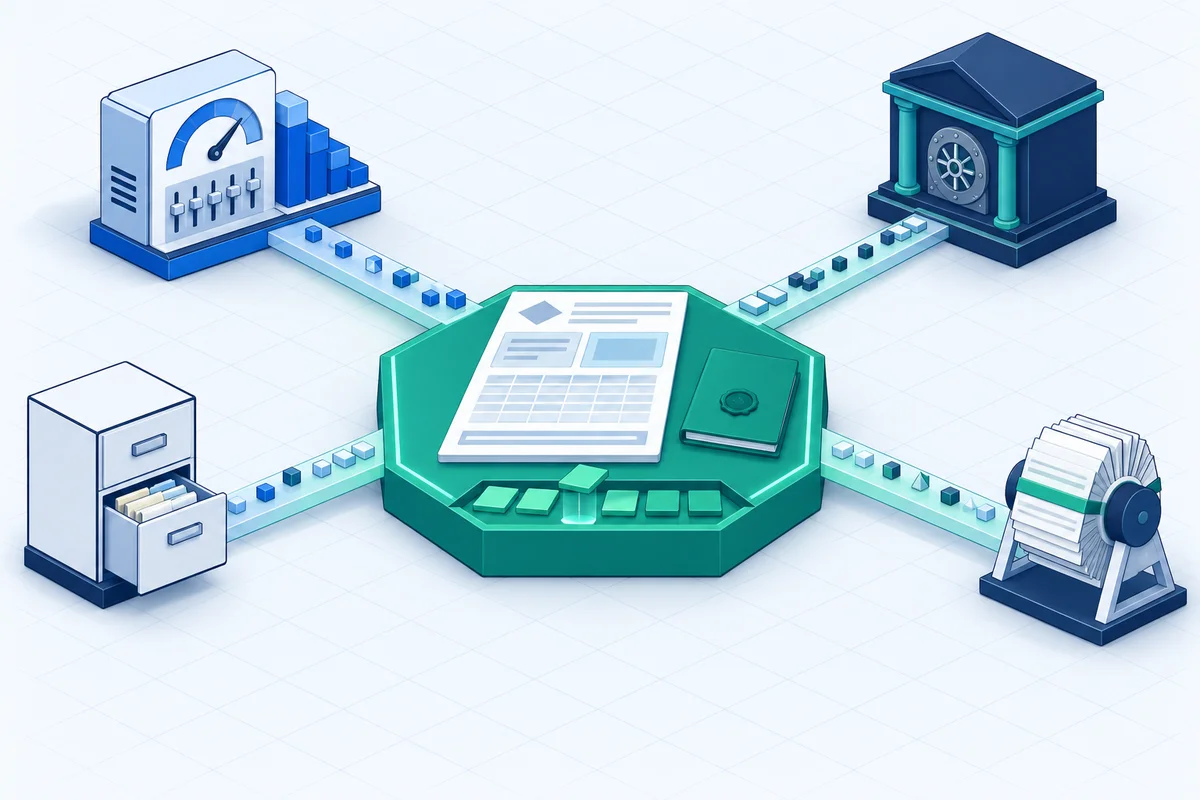
The strongest argument for a dedicated document layer is not technical. It is about who can make a change on a Tuesday afternoon.
Experlogix Document Automation uses a low-code/no-code template builder based on familiar Microsoft Word functionality, so operations and compliance teams can build and amend templates without coding. Template version control keeps teams working from current, approved formats. Smart Forms can collect information that is not already held in a CRM or policy system — for example, a questionnaire issued as part of a workflow, where form completion then triggers document generation. Smart Flows configure the automated flow itself — creation, approval, delivery, e-signature and storage — drawing on data from connected systems and pre-approved variable content such as endorsements, clauses and deductible amounts.
The practical division of labour looks like this: IT and security own integration, identity, environments, monitoring and release control; operations and compliance own wording, templates and approvals; product owners decide jurisdiction, edition and effective-date rules. IT sets it up once; the business runs it thereafter. That is the shift that removes the standing dependency on developers and specialist consultants for routine wording changes.
A word on honest trade-offs. Introducing a document layer means an additional system to integrate, monitor and govern, and it means agreeing boundaries that some teams would rather leave vague. Where a platform already produces adequate output for a narrow, stable document set, keeping it native may be the right answer. The case for centralising strengthens when documents span multiple systems, multiple brands, multiple jurisdictions, or when change frequency outpaces the development queue.
AI-Assisted Document Workflows, With Supervision Built In

AI is useful here in two distinct ways, and it is worth keeping them separate.
The first is configuration assistance: helping draft template logic, suggest content, accelerate workflow design and review documents before they are approved. This shortens the path from "we need a new proposal format" to "the new format is live", while compliance review stays where it belongs.
The second is agent-initiated workflow. Experlogix publishes a Smart Flows MCP (Model Context Protocol) server available in Microsoft Copilot Studio, allowing Copilot agents to discover which Smart Flows exist, see what inputs each one requires, initiate execution, track execution state, and retrieve generated documents and their metadata. The design matters more than the novelty: the agent gathers and validates inputs conversationally, then invokes a governed flow rather than inventing one. Automation logic stays in the flow, not inside the agent, and every execution remains inspectable through the flow execution panel.
Applied to a distribution context, that might look like a producer asking their business AI assistant to prepare a renewal proposal pack for a named client. The agent confirms the required inputs, triggers the approved flow, and returns the finished document — assembled from authoritative data, using the current approved template, routed through the normal approval path, and logged.
What AI should not do in a regulated workflow is decide. Pricing, eligibility, coverage and underwriting judgement remain with authorised people and systems. Every generated document should be traceable, every agent action logged, and the boundaries set by humans.
Summary
The opportunity around BindRabbit is not to change where quoting and binding happen; it is to govern the documents that accumulate around those activities. Start by mapping the document touchpoints across the quote-to-bind and renewal lifecycle, then name an owner for each element: source data, trigger, template, approval, delivery evidence, archive and write-back. Decide deliberately which outputs stay native to each platform and which justify a centralised document layer — typically those spanning several systems, brands, jurisdictions or effective-dated wordings.
From there, the implementation questions are practical ones: define the data contract and authentication model, design for missing data and retries, test batch behaviour against realistic renewal peaks, and confirm that reproducing a historical document returns the correct form edition. Give operations and compliance direct control of templates and wording, keep IT in charge of integration, security and releases, and treat AI as an accelerator that works inside those boundaries rather than around them. Done in that order, a centralised document layer becomes the quiet infrastructure that lets quoting teams move faster while the audit trail takes care of itself.
Frequently Asked Questions
What role does BindRabbit play, and where does document production begin?
BindRabbit operates in the pre-bind portion of the insurance lifecycle: capturing and structuring application data, supporting rating and quoting activity, and helping distribution teams move a submission towards a bound risk. That makes it an operational system for the quoting conversation rather than a system of record for the issued policy.
Where does insurance document complexity arise around BindRabbit?
Insurance wording varies by state, province and region, by product, and by distribution agreement. Multiply those dimensions together and a modest book of business can require hundreds of wording permutations. The complexity is not the number of templates; it is keeping the right wording tied to the right effective date , so that a document reproduced during a dispute or an audit matches what was actually issued.
How should a governed document layer connect with BindRabbit?
Treat the architecture as a chain: a platform event becomes a validated trigger, which prompts governed data retrieval, rule-driven template selection, assembly, approval or signature, delivery, archiving, and a status write-back to the originating system. API-led integration is what makes this dependable.
Who should own document templates, approvals and governed changes?
The strongest argument for a dedicated document layer is not technical. It is about who can make a change on a Tuesday afternoon. Experlogix Document Automation uses a low-code/no-code template builder based on familiar Microsoft Word functionality, so operations and compliance teams can build and amend templates without coding.
What role should governance play in AI-assisted insurance document workflows?
AI is useful here in two distinct ways, and it is worth keeping them separate. The first is configuration assistance: helping draft template logic, suggest content, accelerate workflow design and review documents before they are approved. This shortens the path from "we need a new proposal format" to "the new format is live", while compliance review stays where it belongs.