
PL Rating is Vertafore’s personal lines comparative rating solution, and for many independent agencies it is the first place a personal auto or homeowners risk becomes structured data. Yet the moment a quote comparison is produced, a second, far less automated job begins: proposals, applications, supplemental forms, signature packets, binders, certificates, renewal letters and the servicing correspondence that follows a household for years. Those documents are frequently assembled by hand, or scattered across templates sitting on local drives, which quietly limits how fast an agency can quote, bind and service at volume — and that is the gap PL Rating document automation is meant to close.
TL;DR
- PL Rating owns comparative rating for personal lines: collecting applicant data once and returning carrier quotes for comparison. It is a rating and quoting system, not a document production platform, and it is not the system of record for the agency’s client file.
- Most of the document work around PL Rating happens after the quote: proposals, carrier applications, signature packets, binder confirmations, renewal and remarketing letters, and servicing correspondence.
- The practical question for PL Rating document automation is not which system replaces another; it is which system owns the data, the trigger, the template, the approval, the delivery evidence and the archive.
- A dedicated document automation layer such as Experlogix Document Automation can sit alongside PL Rating and the agency management system, assembling documents from several sources through API-driven integration, with templates maintained by operations rather than developers.
- Governance matters as much as speed: jurisdiction and carrier variations, form editions, effective dates, version control, audit trails and human oversight of anything AI touches.
Happy shiny people. The insurance industry loves the image of policyholders living their best lives, blissfully unbothered by the catastrophes their cover exists to absorb — and a centralised document layer that lets business users manage document automation accurately and quickly, without a standing queue of IT or consulting work, is how the insurance professionals behind those policies get to live their best lives too.
Understanding What PL Rating Owns — and What It Doesn’t
PL Rating sits in the quoting layer of an independent agency’s technology stack. A customer service representative or producer captures applicant, vehicle, driver, property and coverage information once, and the rater returns comparable premium indications from the carriers the agency is appointed with. The value is in the single intake and the side-by-side comparison, which removes the drudgery of rekeying the same household into multiple carrier portals.
That role has three consequences for document operations.
First, PL Rating holds a rich, structured snapshot of the risk at a single point in time — the quote inputs, the coverage selections and the resulting indications. It is excellent source material for a proposal, and almost useless if it stays locked inside the quoting screen.
Second, PL Rating is not the agency’s client system of record. The agency management system — AMS360, Sagitta, or another agency management system such as Applied Epic — holds the client, policy, producer, accounting and activity history. Any document that needs the full client picture, not just the quoted risk, needs data from more than one place.
Third, once business bridges to a carrier for full application, underwriting and issuance, the authoritative policy documents belong to the carrier’s policy administration system. The agency’s documents are the wrapper around that: what was presented, what was signed, what was confirmed and what was filed.
Understanding these boundaries is the whole game. Document automation around PL Rating is not about reproducing carrier policy forms. It is about industrialising the agency-produced documents that bracket the rating event.
Where Document Complexity Emerges in Personal Lines

Personal lines is often assumed to be the simple end of insurance document work. High volume, low variability, surely a mail merge will do. In practice the variability is real; it is just distributed differently than in commercial or specialty lines.
Carrier variation. Every appointed carrier has its own application forms, supplemental questionnaires, disclosure requirements and signature expectations. A proposal that compares five carriers may need five different downstream packets.
Jurisdictional variation. Required notices, disclosure wording, uninsured and underinsured motorist selection and rejection forms, and consumer notices differ by state, province or region, and change on their own schedule. The same quoted risk written in two jurisdictions produces two materially different document sets.
Product and coverage variation. Auto, homeowners, tenants, condominium, umbrella, flood and recreational vehicle all carry their own endorsement language and conditional clauses. Multi-policy households compound this.
Data variation. A proposal pulls the quoted premiums and coverage limits from the rating context, client and producer details from the agency management system, and often branding, disclosure language and approved clause content from somewhere else entirely. Structured data such as vehicle schedules, driver lists, scheduled personal property or mortgagee details needs to be unpacked into readable tables, not dumped as raw fields. Calculations, filtering, look-ups and conditional sections are normal requirements — and historically the point at which agencies start paying developers or consultants.
Volume variation. Day-to-day quoting is interactive and one at a time. Renewal and remarketing seasons are not. Nor are mass carrier rate-change notifications or post-event communications after a regional catastrophe. A document approach that only works one document at a time will struggle precisely when the business is under the most pressure.
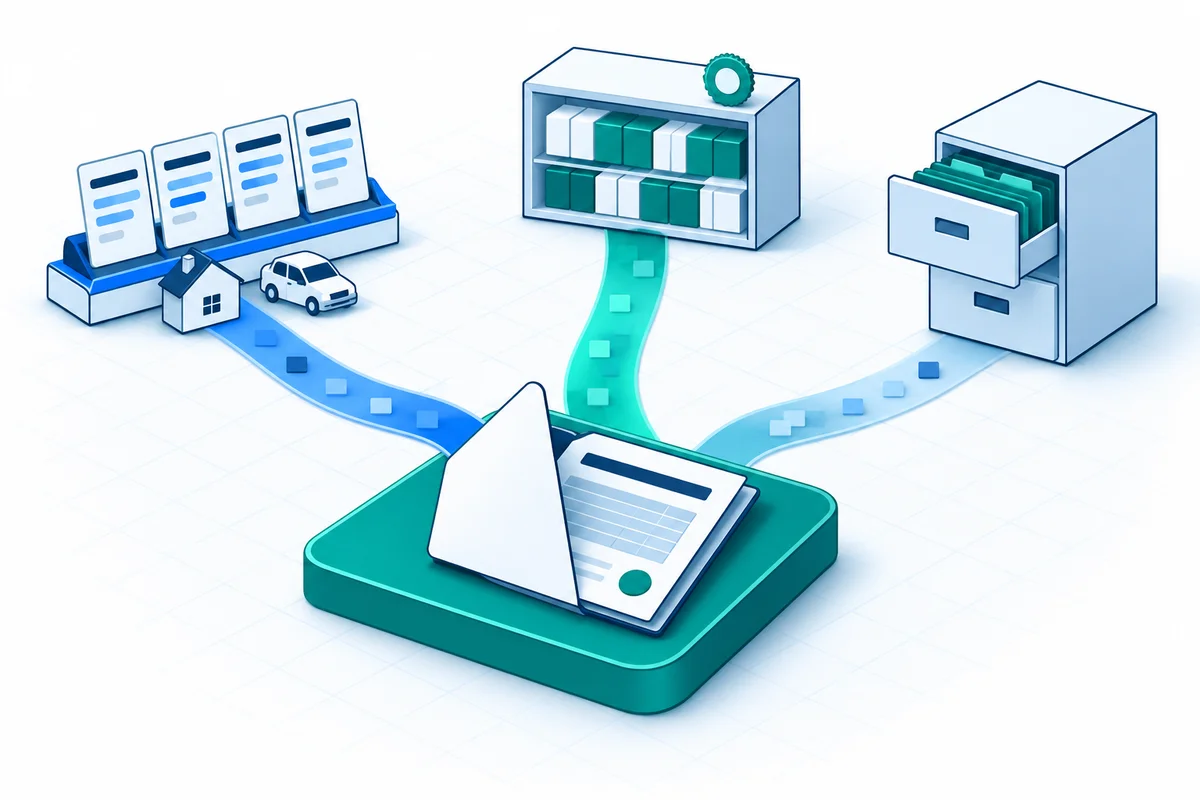
A completed PL Rating quote triggers the document layer, which pulls data from PL Rating, the agency management system and the content library, assembles an approved template, routes it for approval and signature, then delivers and archives it with an audit trail.
The Document Workflows That Bracket a Rating Event
It helps to map the lifecycle explicitly rather than talk about "documents" in the abstract.
Each of these has a trigger, an owner, a required content set, a delivery channel and a retention expectation. Writing that down for your own agency or programme is the single most useful exercise before evaluating any tooling.
Before and at quote
- Intake and information-gathering forms, including prior-carrier and loss-history questions
- Comparison proposals presenting coverage options and premium differences in the agency's own branding
- Coverage recommendation summaries and declined-coverage acknowledgements
At bind
- Carrier application packets and supplemental forms
- Required jurisdictional notices and selection or rejection forms
- Electronic signature packets and payment authorisation forms
- Binder confirmations and evidence of insurance, including auto identification cards and evidence of property insurance for lenders
After bind and through the term
- Welcome letters and policy-delivery correspondence
- Endorsement request confirmations, mid-term change summaries
- Billing and premium-change notices, cancellation and lapse communications
- Claims acknowledgement and status correspondence sent by the agency
- Renewal review letters, remarketing comparisons and non-renewal notifications
Integration Architecture for PL Rating Document Automation
Document generation around a rating platform is fundamentally a multi-source problem, and that is an architecture question rather than a template question.
An API-driven approach is the clean way to solve it. Experlogix Document Automation provides a flexible API with role-based API keys and an extensive library of API calls, so document generation and workflow steps can be invoked directly from the applications and automations an agency already runs. A trigger — a completed quote comparison, a bind confirmation, a renewal task, a scheduled batch — calls the document layer with a defined data payload; the document layer retrieves whatever else it needs from connected sources, selects the correct templates and content, assembles the output, routes it for approval or signature, delivers it and stores it.
This is a one-time integration design that keeps paying back. It is configured once, with the data contract agreed between the teams who own each system, and after that new document types, new carriers and new jurisdictions are template and rules changes rather than development projects. Because the integration is API-led, it scales naturally from a single interactive proposal to a scheduled renewal run, and AI assistance can help accelerate the configuration work itself.
Practical items to specify during that design:
- Data contract: which fields come from the rating context, which from the agency management system, which from the content library; how nested structures such as vehicle and driver schedules are represented; what happens when a value is missing.
- Identity and access: service identities for system-to-system calls, role-based permissions for business users, and least-privilege principles for anything touching personally identifiable information.
- Trigger pattern: synchronous generation where a human is waiting at their desk, queued or scheduled generation for batches and overnight runs.
- Failure handling: idempotency so a duplicated trigger does not produce two binders, retry rules, partial-batch reconciliation, delivery-failure handling, and monitoring that tells someone when a run did not complete.
- Write-back and archive: where the finished artefact is stored, what metadata accompanies it, and what reference is written back to the originating system so the document is discoverable from the client file.
Experlogix Document Automation can connect to multiple data sources and includes delivery and storage automation plus plug-and-play connections to major eSignature platforms including DocuSign, Adobe Acrobat Sign, OneSpan Sign and ConsignO, alongside integration with Microsoft Power Automate and SharePoint. For agencies already standardised on the Microsoft stack, that matters: the approval and routing patterns people already know can be reused rather than rebuilt.
Business Ownership: Who Should Be Changing Templates

The strongest operational argument for a dedicated document layer is who gets to make changes.
When a state, province or region updates a required notice, or a carrier revises its application, or marketing refreshes the agency's branding, the change should be a documented, reviewed edit by the person who understands the requirement — not a ticket that waits behind a development backlog.
Experlogix Document Automation is built around that principle. The Template Builder is a Microsoft Word add-in, so templates are authored in the tool business users already know, with dynamic data integration, conditional content, data-driven tables, expressions, language variations and version control. Smart Flows provides low-code, drag-and-drop workflow modelling so business users can design how documents are generated, approved, delivered and stored. Smart Forms capture inbound data digitally and can trigger document generation on submission. The Content Manager acts as a governed repository for templates, PDF forms, logos, images and other assets, organised in a familiar folder structure with metadata, search and automatic versioning — including the ability to roll back, compare changes and maintain a complete audit trail.
The honest trade-off is that business ownership is not the same as business free-for-all. Someone still has to define who may edit which templates, who approves changes before they reach production, and how a change is tested before a renewal batch goes out.
IT and security retain integration, identity, environment and release control. Compliance retains approval authority over controlled wording. The win is not that governance disappears; it is that the people exercising governance no longer need a developer to execute their decisions.
Compliance, Evidence and Effective-Dated Content
Agencies are not usually the filing entity, but they are very much the entity that has to prove what it sent.
Three governance capabilities carry most of the weight:
Version and edition control. Templates and content must be versioned, with the ability to establish which version was in force when a document was produced. Reproducing a document from two years ago means reproducing the content as it existed then, not as it exists now.
Jurisdictional rules in the template, not in people's heads. Embedded business rules that apply the correct jurisdiction-specific language and disclosures remove the guesswork and the risk of someone reaching for last year's letter.
Audit trails. Edits, approvals and timestamps logged through the system, with metadata tagging and automated archiving so documents can be retrieved quickly during an audit or an errors-and-omissions enquiry. The evidence question to answer is always the same: which template, which data, which approver, which signature, which delivery channel, which retention rule.
AI and Automation, Kept Inside the Guardrails
AI in insurance document work is most defensible where it speeds up configuration and review rather than where it decides anything.
Experlogix applies AI at design time rather than run time: the platform's AI helps users design templates, trigger automated workflows and create intake forms faster, but it is not used to produce the final output. For a personal lines operation, that distinction is the difference between an assistant that helps an operations analyst build a renewal letter flow in an afternoon, and a system improvising coverage wording in front of a customer.
Experlogix Document Automation also offers the Smart Flows MCP Server — MCP, or Model Context Protocol, being the emerging standard that lets AI agents connect to existing systems in a structured, auditable way. The useful pattern is an agent that can initiate a governed workflow: a service team member asks for a renewal comparison packet for a household, the agent invokes the defined workflow, the workflow sources data from the authorised systems, selects approved templates, assembles the document and routes it for the normal approvals. Every document generated is traceable and every agent action is logged, with humans retaining control over where the boundaries sit.
What should never be delegated: coverage, eligibility, pricing and underwriting judgement. Those stay with authorised people and authorised systems, and the document layer records what they decided rather than deciding for them.
Architectural Trade-Offs Worth Being Honest About
A centralised document layer is one reasonable approach, not the only one. Some considerations before committing:
- Scope discipline. If the only requirement is one branded proposal, a lighter tool may be proportionate. The case for a dedicated layer strengthens with multiple carriers, multiple jurisdictions, multiple brands or multiple source systems.
- Up-front design effort. The data contract and template estate need real thought. The payoff is in year two and beyond, when changes are configuration rather than code.
- Consolidation opportunity. Agencies and programmes typically run documents out of several systems at once — the rater, the agency management system, a CRM, spreadsheets. Centralising templates, branding and workflow onto one governed layer across those systems is usually where the largest operational gain sits, because one approved clause change propagates everywhere instead of being re-applied in five places.
- Testing at peak. Interactive generation and renewal-season batches are different performance profiles. Test both before you need both.
Summary
PL Rating does what a comparative rater should do: it turns a personal lines enquiry into structured data and comparable carrier indications quickly. The document burden lives on either side of that event, in proposals, application packets, signature workflows, binders, renewal communications and servicing correspondence — and that burden is where agencies tend to lose operational agility.
The productive framing is complementary, not competitive. Leave rating with the rater, client and policy records with the agency management system, and issued policy documents with the carrier. Then decide deliberately which documents justify a governed document layer of their own, and design the integration to match: clear data contracts, defined triggers, sensible failure handling, controlled identity, and an archive that produces evidence on demand.
A reasonable next step is a short mapping exercise. List every document your team produces around a quote, mark its trigger, its data sources, its jurisdictional variations, its approver and its retention requirement, then count how many of those currently require a developer or a consultant to change. That count, more than any product comparison, will tell you whether a centralised document automation layer belongs in your architecture — and how much of your team's week you would get back by building one.
Frequently Asked Questions
What role does PL Rating play, and where does document production begin?
PL Rating sits in the quoting layer of an independent agency's technology stack. A customer service representative or producer captures applicant, vehicle, driver, property and coverage information once, and the rater returns comparable premium indications from the carriers the agency is appointed with.
Where does insurance document complexity arise around PL Rating?
Personal lines is often assumed to be the simple end of insurance document work. High volume, low variability, surely a mail merge will do. In practice the variability is real; it is just distributed differently than in commercial or specialty lines. Carrier variation.
Which document workflows extend around PL Rating?
It helps to map the lifecycle explicitly rather than talk about "documents" in the abstract. Each of these has a trigger, an owner, a required content set, a delivery channel and a retention expectation. Writing that down for your own agency or programme is the single most useful exercise before evaluating any tooling.
How should a governed document layer connect with PL Rating?
Document generation around a rating platform is fundamentally a multi-source problem, and that is an architecture question rather than a template question. An API-driven approach is the clean way to solve it. Experlogix Document Automation provides a flexible API with role-based API keys and an extensive library of API calls , so document generation and workflow steps can be invoked directly from the applications and automations an agency already runs.
Who should own document templates, approvals and governed changes?
The strongest operational argument for a dedicated document layer is who gets to make changes. When a state, province or region updates a required notice, or a carrier revises its application, or marketing refreshes the agency's branding, the change should be a documented, reviewed edit by the person who understands the requirement — not a ticket that waits behind a development backlog.