If you run Salesforce CPQ, you are probably being asked a simple question with no simple answer: how long would a move actually take? Salesforce stopped selling Salesforce CPQ to new customers in 2025, so planning conversations are happening now. Existing customers can still use the product, renew it, add users and get support. This article explains what drives a Salesforce CPQ migration timeline and how the work differs by path. It also shows you how to build a credible estimate for your own environment instead of borrowing someone else's.
TL;DR
- There is no universal Salesforce CPQ migration timeline. Duration is driven by catalog complexity, custom logic, integrations, data quality, renewal and amendment history, document templates, testing depth, and rollout model.
- Salesforce CPQ is end of sale, not end of life. Salesforce has not announced an end-of-life date, so you can sequence the work deliberately rather than under deadline pressure.
- Moving from Salesforce CPQ to Revenue Cloud Advanced (RCA, now part of Agentforce Revenue Management) is a reimplementation on a different data model, not an upgrade. Plan it as a redesign project with a full implementation timeline.
- Replacing only the quoting layer while keeping Salesforce CRM is a narrower scope. CRM objects, reporting, and security stay in place, so the project centers on product modeling, pricing rules, and document output.
- Staying on Salesforce CPQ is a legitimate near-term option. It is not a permanent answer, so you need to revisit the decision at each renewal cycle.
- The single biggest timeline variable is not the software. It is how much undocumented logic lives in your current configure-price-quote (CPQ) implementation.
Why There Is No Standard Salesforce CPQ Migration Timeline
Any vendor who quotes you a fixed Salesforce CPQ migration timeline before seeing your catalog is guessing. Two companies with identical license counts can differ by many months because the work scales with logic and data, not users.
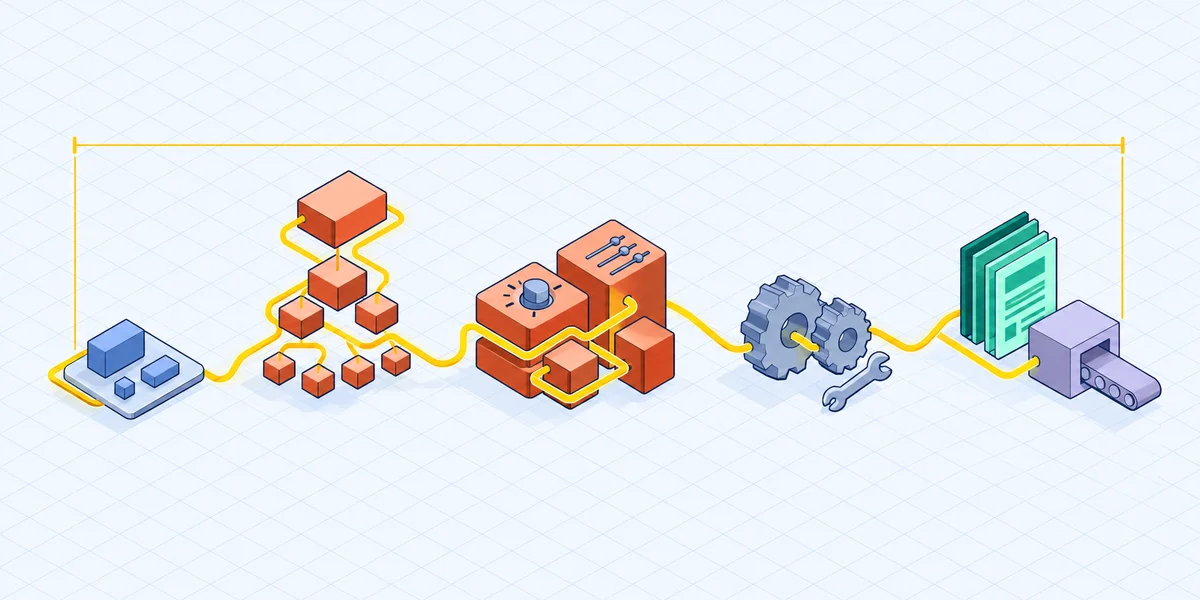
The variables that actually move the calendar:
- Catalog size and shape: flat SKU lists move quickly; deeply nested bundles with option constraints do not.
- Rule inventory: product rules, price rules, discount schedules, and constraint logic accumulated over years, often without current documentation.
- Custom code: Quote Calculator Plugin (QCP) scripts, Apex, triggers, and flows that extend pricing behavior must be understood, re-expressed, and regression tested.
- Integration surface: enterprise resource planning (ERP) handoff, contract systems, billing, tax, and any middleware in between.
- Data migration scope: open quotes, contracts, subscriptions, assets, amendments, and historical pricing that must be carried forward, transformed, archived, or left read-only.
- Documents: quote, proposal, and order form templates that must produce output your customers and legal team accept.
- Organizational readiness: whether you have an owner who can make product and pricing decisions quickly.
A practical rule: the discovery and rule-rationalization phase almost always takes longer than anyone budgets, and testing almost always takes longer than the build.
The Three Paths and How Their Timelines Differ
Your Salesforce CPQ migration timeline depends first on which path you choose. There are three, and they are not equally sized. This section focuses on how each path affects the calendar. For a full comparison of capabilities and fit, see which path fits complex quoting.
Path 1: Stay on Salesforce CPQ for now
Timeline impact: none in the near term, with a recurring review commitment.
End of sale means Salesforce no longer sells Salesforce CPQ to new customers. It does not mean your licenses stop, your renewals are blocked, or support ends, because end of sale is not end of life. Salesforce has not announced an end-of-life date. What has changed is investment direction. Salesforce CPQ now sees limited new feature development, and the roadmap sits with Revenue Cloud Advanced.
This path suits teams with a stable catalog, moderate quoting complexity, and higher-priority projects competing for the same admin and IT capacity. Salesforce CPQ still handles moderate-complexity quoting well. The cost of staying is opportunity cost. Unresolved limitations stay unresolved, and the eventual project does not get smaller while your rule base keeps growing.
To stay on this path safely, schedule a decision review at each renewal. Each review should include a short written assessment of what changed in your products, your pricing models, and Salesforce's roadmap.
Path 2: Revenue Cloud migration (reimplementation)
Timeline impact: a full implementation timeline, planned as a redesign.
Treat a Revenue Cloud migration as a new build. Salesforce documents Revenue Cloud Advanced as a different architecture and data model, with an attribute-based catalog and a different approach to pricing configuration. Your existing bundles, product rules, price rules, and QCP logic do not lift and shift. They are re-expressed in a different modeling paradigm, which means the design phase is substantive rather than cosmetic.
Phases that dominate this path:
- Discovery and inventory of every bundle, rule, script, approval, template, and integration in the current Salesforce CPQ org
- Catalog and pricing redesign in the target model, including decisions about which legacy behaviors to retire
- Rebuild of approvals, documents, and downstream handoffs
- Data migration planning: what transfers, what transforms, what gets archived for historical reporting
- Regression testing against real historical quotes, plus renewal and amendment reconciliation
- Coexistence and cutover, including a parallel-run period for in-flight deals
The reimplementation path makes sense if you want a single Salesforce revenue platform for quoting, contracts, billing, and usage-based models. You also need the budget and change capacity for a redesign.
Path 3: Keep Salesforce CRM, replace the quoting layer
Timeline impact: narrower scope than a full platform reimplementation, because the CRM stays.
On this path, Salesforce CRM remains the system of record for accounts, opportunities, and reporting, and you replace the configure-price-quote layer. The scope shrinks in a specific way. You do not re-platform your CRM data model, re-point your reports, or rebuild your security and sharing model. The project concentrates on product modeling, pricing and discount logic, approvals, and document output.
Experlogix CPQ is one option in this category. It integrates with Salesforce and has out-of-the-box capabilities to read and write to CRM data, so you don't need a custom integration build. Quoting works against CRM data where it lives. That architecture shortens the implementation timeline in two ways:
- It reduces the work you would otherwise spend on middleware, field mapping, and reconciliation logic.
- It shrinks the risks that delay go-live: stale records between systems, sync failures, duplicate records, and reports built on a copy of the data instead of the source. Those risks are smaller when you are not copying data into a separate platform and syncing it back.
Experlogix CPQ is a low-code solution. Business users and admins control configuration rules, pricing, and workflows, which affects the timeline after go-live as much as before it. When admins can change rules and templates without consultants, your change backlog stops being a scheduling dependency. Its depth is strongest in complex configuration, including:
- detailed product rules and dependencies
- guided selling
- quoting that combines products, services, and recurring revenue
- bill-of-materials (BOM) output ready for ERP handoff in manufacturing scenarios
This path is not right for every team. If your quoting is simple, the Revenue Cloud path may be the better destination even though it takes more calendar time. The same applies if you are committed to consolidating quoting, billing, and usage on a single Salesforce revenue platform.
Building Your Own Estimate: A Scoping Method That Holds Up
Replace the question "how long does a Salesforce CPQ migration take" with "how large is our logic inventory, and how much of it survives?" Then size the work from evidence.
Run this sequence before you ask anyone for a date:
- Inventory the environment: count bundles and nesting depth, product rules, price rules, discount schedules, approval paths, QCP scripts and Apex, templates, integrations, and reports that depend on CPQ objects.
- Classify each item as keep, simplify, or retire. Legacy rules that exist only to patch earlier rules are the fastest wins.
- Pick 10 to 20 golden quotes covering your hardest real deals. Include nested configurations, renewals with inherited discounts that test renewal and amendment reconciliation, ramp schedules, and mixed revenue. These become your acceptance tests.
- Scope the data migration explicitly: which open quotes, contracts, subscriptions, assets, and amendments move, which transform, and which stay read-only for historical reporting.
- Decide the rollout model: big-bang cutover, phased by business unit or product line, or parallel run. Phased rollouts extend elapsed time and reduce risk per release.
- Add a rollback plan. A go-live without a defined fallback is a timeline risk disguised as a date.
Each item above is a line in your implementation timeline. An estimate built this way holds up in front of a steering committee, and the schedule changes with scope instead of guesswork.
The Bottom Line on Salesforce CPQ Migration Timelines
No credible answer to the Salesforce CPQ migration timeline question starts with a number. It starts with scope. Catalog complexity, accumulated rules and QCP customizations, integration surface, data migration decisions, document parity, and testing depth set the calendar, and the path you choose sets the ceiling.
Staying on Salesforce CPQ costs no project time now and remains viable, because no end-of-life date has been announced. A Revenue Cloud migration is a reimplementation on a different data model. Budget it as a redesign with a full implementation timeline. Keeping Salesforce CRM and replacing only the quoting layer narrows the scope to product modeling, pricing, approvals, and documents. If the new quoting tool reads and writes CRM data directly, you also avoid a whole category of sync and reconciliation work, both during the project and after go-live.
Teams that finish these projects on schedule have one thing in common: they understood their own logic before they evaluated anyone's software. Start there this quarter. Pull a complete inventory of your Salesforce CPQ bundles, rules, QCP scripts, approvals, and templates. Mark each one keep, simplify, or retire, and assemble your set of golden quotes. That inventory is the foundation of every realistic timeline you will be asked to produce.
FAQ
How long does a Salesforce CPQ migration take?
There is no standard duration. The timeline depends on your path and your scope: catalog complexity, rules and QCP customizations, integrations, data migration decisions, document templates, testing depth, and rollout model. A Revenue Cloud migration needs a full implementation timeline because it is a redesign. Replacing only the quoting layer while keeping Salesforce CRM is a narrower project. Build your estimate from an inventory of your current environment rather than a generic benchmark.
Does Salesforce CPQ data migrate directly to Revenue Cloud?
Not as a lift and shift. Revenue Cloud Advanced uses a different architecture and data model, with an attribute-based catalog and a different approach to pricing configuration. Bundles, product rules, price rules, and QCP logic have to be re-expressed in the new model. Open quotes, contracts, subscriptions, and amendments need explicit decisions about whether they transfer, transform, or are archived.
What data must be rebuilt, transformed, archived or retained during a CPQ migration?
Configuration logic is typically rebuilt: bundles, product rules, price rules, discount schedules, approvals, and templates. Active commercial records such as open quotes, contracts, subscriptions, assets, and amendments usually need to be carried forward or transformed into the target structure. Historical quotes and pricing that you need only for reporting can often be archived or left read-only. Make these decisions explicitly during scoping, because each one adds or removes work from the timeline.
What are golden quotes in a CPQ migration?
Golden quotes are a set of roughly 10 to 20 real deals that represent your hardest quoting scenarios. Examples include nested configurations, renewals with inherited discounts, ramp schedules, and mixed revenue. They serve as acceptance tests. The new system must reproduce their configuration, pricing, and output correctly before you go live.
Should a CPQ migration be big-bang, phased or parallel?
It depends on your risk tolerance and organizational capacity. A big-bang cutover is the shortest in elapsed time but concentrates risk in a single release. A phased rollout by business unit or product line extends elapsed time and reduces risk per release. A parallel run lets in-flight deals finish on the old system while new deals start on the new one. Whichever model you choose, define a rollback plan before go-live.
Scope a Migration That Keeps Salesforce CRM in Place